shekou upgrades part the second


green panels

the transformation of shenzhen from an industrial processing zone into a center of creativity continues, this time with a green twist. rennovation of the old sanyo factories in shekou has begun. panels with green plants have been attached, giving the area an environmental conscious atmosphere, even though i don’t think the plants do anything but grow. pictures here.

new squatters


abandoned wanxia village, old shekou

this week, my good friend steve came to shenzhen. as we were walking around shekou (from seaworld toward the new pennisula housing estates/dongjiaotou/wanxia village remains), he asked if shekou had become seedier, focusing me on something i’ve noticed but not registered: the quality of life of shenzhen squatters has deteriorated. previously, many lived in the older remnants of inner city villages. however, with the rennovate the inner city villages (旧村改新) in full swing, much of that cheap, squalid, but solid with some kind of sanitation and running water housing stock is vanishing. instead, squatters are building more and more temporary housing on the fewer and fewer boundaries between the expanding city and remains of baoan county.

the erasure of impromptu vegetable gardens symbolizes the increased transience of squatter settlements. indeed, the vegetable gardens once symbolized alternative economic possibilities for those outside the formal economy. it is a dangerous world, when illegal gardens come to symbolize spaces of urban possibility for new migrants. this is, of course, most visible at seaworld, where the last of the oyster farmers are being swept away, and new generation of squatters have moved onto the garbage and landfill heaps that constitute the new coastline. two years ago, the oyster farmers not only had houseboats, on land, they had more or less permanent installations for processing oysters. today, only a few remain, and they are clearly leaving. soon.

pictures from the past three or four months.

shekou upgrades


demolished building, taizi street, shekou

went for lunch at a favorite italian restaurant and what did we see? the rage for renovation continues to transform the city. along taizi road, the main strip in front of seaworld, three areas are under re-construction: the cluster of sanyo factories from the early eighties is being turned into a creative industries center. they have just begun removing walls, but it may in fact turn into another area of glass and black walls. across the street from seaworld is times plaza, where the old sushi restaurant has been torn down. architecturally it was relatively recent and boasted a waterwall; the building was glass and water fell down the sides filling a pool (moat?) that surrounded the building. further east, one of the old office buildings has been torn down, and with it the shops that used to sell cantonese-sized faux couture– in u.s. sizes i wear an 8 or medium, in the world of cantonese-sized faux couture i am an extra, extra-large. also, another building that has not yet been demolished has nevertheless been repainted bright yellow. for the interested, pictures, here.

neon update: it occurs to me that the neon lights are a good way of upgrading without demolishing buildings or painting them bright yellow. although i kind of like the bright buildings that are starting to show up. the shekou china communications building is a late eighties early nineties examplar of state-of-the-art. just recently it has been caged. at night, and from a distance, the building tower is now a relatively clear television that broadcasts commercials and public service announcements… there’s another downtown television is strictly advertising, lately l’oreal for men and cars…


shekou china communications building and moon

also, a graffiti update: someone is still at work re-covering walls.


shekou graffiti

only four years ago

Saturday, all day, dreary clouds flattened Shekou grey. Trucks rumbled through landfill dust, which coated pedestrians and fengshui trees, parked cars and potted plants. I walked to the Dongjiaotou Port Area (东角头港区), located on the eastern edge of Shekou, where once upon a time, workers unloaded building materials shipped from Foshan and Shunde. Only 4 years ago, I photographed fishing boats berthed where today the Peninsula residential development rises in the shadow of the western corridor bridge, which will link western Shekou to Hong Kong. Yes, these were the fishing boats that used to supply Shekou’s fresh seafood restaurants (大排挡). And yes, the Peninsula is part of the move to gentrify Shekou. I’m not sure if it’s the weather, the inevitable dust, the scale of the change, or D all of the above that has me feeling bereft, but today, I didn’t want to look. Below, two views of Dongjiaotou, one circa 2003, the other circa 2007. More comparisons, more dust, and a few detours into Old Shekou side streets, here.


fishing boat harbor, dongjiaotou west (facing nanshan), 2003


new road, dongjiaotou west (facing nanshan), 2007

赤湾天后宫:vexed tradition


tianhou brigade

In 2004, the Tianhou Museum and the Nanshan Mazu Culture Research Association edited a volume of couplets and poetry that had been written in honor of the Tianhou. There were two first place couplets:

赤湾伊始,敞帮门,发舟旅,西洋七下,铺开海上丝绸路;
天后岂终,携郑坚,邀邓公,南洋千寻,赢得人间锦锈春。(作者:种显泽)
(In the beginning, Chiwan opened its gates, sent out Zheng He’s ships to the four oceans, establishing the maritime Silk Road;
In the end, Tianhou lead Minister Zheng, greeted Lord Deng, a southern port of 1,000 miles, earning a brilliant spring. by: Zhong Xianze)

赤湾旭日膦人精,
天后慈云笼海疆。(作者:吴北如)
(Chiwan dawns, looks toward humanity,
Tianhou’s benevolent clouds cover the seas. by: Wu Rubei)

These two poems illustrate the contradiction between official culture and local belief that enables the Chiwan Tianhou Temple to operate. Legally, the Temple grounds constitute the Tianhou Museum, where the Nanshan Mazu Culture Research Association is based. Specifically, in Shenzhen, the largest and most public temples are officially museums and research centers. However, the contributions and activities of believers sustain the spaces as temples, especially on important holidays. Thus, in the first poem (and it was actually the gold first prize, the second poem was the silver first prize) emphasizes the Temple’s political importance, linking the voyages of the Ming eunich Zheng He to the open policies of Deng Xiaoping. In contrast, the second poem celebrates Tianhou’s divine benevolence.

Helen Hsu and others have written about the post-Mao resurgence of tradition throughout Guangdong. In Shenzhen, this resurgence has taken an interesting twist precisely because even though there are locals working to promote Tianhou, the museum and research association have been headed by immigrants from northern cities. Consequently, the two poems don’t only manifest a contradiction between “official” and “unofficial” culture—although many westerners like to paint Chinese public life in terms of an opposition between the Party and everybody else—but also between urban and rural belief systems, as well as northern and southern traditions. For most of the museum and research staff (and there are fewer then there were when I first went to the museum in 1997), allowing people to burn incense is a concession to local superstition. And yes, northern urban attitudes about Guangdong traditions can be as condescending as it sounds. Publicly, however, they take the route of the first poem, understanding Cantonese history and traditions within the scope of imperial China. At the same time, the few believers I’ve talked to, follow the route of the second poem, focusing on belief, and remaining quiet on the issue of national politics.

That said, there’s enough history at Chiwan’s Tianhou Temple to satisfy everyone, unless of course you don’t care about either imperial history or Tianhou’s benevolence. The temple was built at the end of the Song Dynasty, but achieved national prominence during the Ming Dynasty, when the Minister Zheng He led his famous maritime voyages to establish a maritime trade routes. During the second expedition, he and his crew ran into inclement weather of the coast of the Nantou Peninsula. Zheng He promised to restore the temple in return for Tianhou’s help in surviving the storm. She did help him and in the 8th year of the reign of the Yongle Emperor (1410), the Chiwan Tianhou Temple was restored.

The fame of the Chiwan Tianhou’s benevolence spread throughout the country and throughout the Ming and Qing Dynasties, believers—both official and unofficial, northern and southern, but all predominantly sailors or fishermen—continued to restore and add to the temple. At the beginning of the Nationalist era, Chiwan was the largest Tianhou temple in Guangdong with over one hundred and twenty buildings in the complex. Once the communists liberated Bao’an County (Shenzhen’s territorial precursor), the PLA moved into the facilities. In 1959-1960, many of the wood, tiles, and bricks from the temple were used to construct the Shenzhen Reservoir. It was only in 1992, that the recently established Nanshan District government began to restore the temple. The museum was officially opened in 1997 as part of efforts to prepare for the return of Hong Kong to Chinese sovereignty. It was, as many said at the time, recognition of the common cultural origins of Shenzhen and Hong Kong.

This weekend was the first time I had been back in a while. Not a believer, I chafe at paying the 15 rmb museum entrance fee, when the museum isn’t all that great. However, the changes suggest that elegant political poetry notwithstanding, the believers have slowly taken over and there may be times when visiting Tianhou is worth the price of admission. There are now monks on duty, telling fortunes and instructing people how to pray. There are rooms filled with multiple castings of the same god, where believers light incense. And one of the museum exhibition rooms has been turned over to photographs of important religious events at the temple, the largest being Tianhou’s birth on the 23 day of the third lunar month (this year, may 9). Indeed, the photography seems much in the spirit of the poetry competition: the museum staff’s attempt to get control of the space back, this time through public cultural events.

According to the Xin’an County Gazetteer, the Chiwan Tianhou Temple once held pride of place in the eight scenic areas of Xin’an (Bao’an County’s name during the Ming and Qing Dynasties). The other seven were: 梧岭天池,杯渡禅宗,参山乔木,卢山桃李,龙穴楼台,螯洋甘瀑,玉律汤湖. I don’t know what or where most of those sites are (although wuling must mean the wutong mountains in the east) and look forward to mapping them. However, what’s interesting here is the way historic records follow names rather than places. History as documentation and re-inscription with a vengence. In 1983, when the SEZ was established as administratively separate from New Bao’an County, all of the history from Bao’an county moved into Bao’an, even though most of that history had taken place in (what is now) Nanshan District. Chiwan, Shekou, and the County Seat at Nantou were the important historical sites. However, to find out pre-reform information on them, one must cross the second line into (what is now) Bao’an District and head to the Bao’an District Library. I remember talking with the editor of the last ever Bao’an Gazetteer. He did his research and oral history throughout the SEZ, but his office was in Bao’an County. At the time, I needed to carry my passport with me so that I could cross back into the SEZ after a visit. Of course, this is simply another variation on history in the Pearl River Delta, where scholars of Hong Kong history continue to refer to the SAR’s territorial precursor as Xin’an, without noting that the name changed in 1913. (Sometimes I suspect that Shenzheners’ attempts to annex Hong Kong by way of historical documentation is only matched by Hong Kong people’s efforts to write themselves as historically distinct from Shenzhen. Everyone sidesteps the issue by writing these historic trajectories from the Opium War on, where Hong Kong grows out of Xin’an, and then Shenzhen emerges out of Bao’an.)

This time, I kept noticing industrial parallels between the containers stacked up just outside the Temple Gate or loaded just beyond the Temple Walls and the brigades of god images. Little statues of Tianhou, Guanyin, and the God of Wealth were everywhere and never just one, instead in any room, there were shelves of the same statue, almost like a religious market, except they were all receiving incense. Brigades on view here. Questions about the vexed relationship between political-economy and faith, merely posed.

signs of various kinds


it’s not easy being a prostitute

back in shenzhen, wandering the streets of shekou, reorienting myself to newly paved roads and recently razed sites. signs of all kinds assault the eyes: graffiti (of varying quality), the ubiquitous advertizing (even garbage cans can be rented to eager merchants), and, of course, deng xiaoping’s calligraphy, which once confirmed reform and now is itself advertizing for the seaworld plaza. a selection of signs, here.

seaworld’s other: the itinerant oyster farmers


the oyster coast

although histories of shenzhen often begin by reminding the reader that the city was once a small fishing village, nevertheless, the closest that most residents and visitors have come to the local fishing industry is on the yantian coast, where seafood restaurants crowd the space around the docks. in western shenzhen, the local fishing industry has been increasingly pushed away as the houhai land reclamation project moves the coastline closer to hong kong. this pushing increased at the turn of the millenium, when more upscale projects started reshaping local neighborhoods. however, it is only in the past two or three years, as the building projects have finished and new people moved in, that gentrification has successfully ousted most of the fishing industry. indeed, in the shadows and grind of a multi-building elite housing estate, i lost one of my favorite seafood restaurants, which had specialized in shellfish.

just beyond the the seaworld plaza, where nuwa holds up the sky, people gather to look at the ocean and the odd fishing boat. after breakfast, a friend and i walked down there; she to visit one of shenzhen’s well-known tourist sites, me to see if anything had changed. and it had. oyster farmers had occuppied the stretch of coast from nuwa toward rose garden estates and oyster shells now covered the area, creating the land for makeshift docks and oyster processing. in addition to harvesting oysters to sell throughout shenzhen, farmers were shelling and drying oysters to make oyster sauce, and then drying and grinding the shells to make a calcium supplement for animal feed. interestingly, many were not originally oyster farmers, but working on the boats for the season, after which they will look for other agricultural work.

pictures of seaworld’s other, here.

old shekou


storefront, old shekou

this weekend judi, xiaomei and i went costume shopping. as they figured out a look for a female pozzo, i wandered the streets of old shekou, wondering when these scenes of early reform would be replaced with more contemporary versions of modernity. once upon a time, only twenty years ago, shekou was new and improved, a beacon for shenzhen’s trail blazers, who had come to build a special economic zone without any idea what that might mean. at the time, even if these latterday pioneers spoke of reform in quite uncertain terms: feeling the rocks to cross the river (摸着石头过河), nevertheless they also spoke of a particular energy: the shenzhen spirit. hopeful, young, at the cusp. today, that world is already outdated and those young visionaries middle-aged. i have posted a few scenes of old shekou.

shekou: symbols of globalization

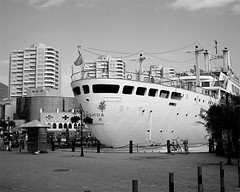
Although my last entry about Bitao Alley focused on one architectural manifestation of globalization in Shekou, the most famous architectural sign of Shekou’s march to a global future is in fact the Minghua luxury liner.

Over twenty years ago, the Shekou People’s Government bought the Minghua from France and docked it in the port. At the time, the Minghua floated and Chinese guests had a sense of embarking on an international cruise. In 1984 Deng Xiaoping boarded the Minghua and, pleased with what he saw, wrote the four characters for seaworld (海上世界), which now grace the ship’s entrance. Throughout the 80s, the Minghua symbolized exotic consumption. Western restaurants and shops sprung up in the area around the ship; this is today’s Seaworld Plaza. However, by the 90s, the Nanshan District, Houhai land reclamation had spread along the coast, landlocking the Minghua. The ship fell into disuse and the newly created land next to it was turned into a golf practice field. At the turn of the millennium, Seaworld Plaza underwent an international facelift and the Minghua was restored as a luxury hotel and restaurant.

For Chinese visitors to Shenzhen, Seaworld Plaza is an important destination. They buy foreign knicknacks at kiosks, take their picture in front of the Minghua, and sometimes enjoy a foreign meal. Next, they walk along the ocean walk to take their picture with Nuwa, who saved humanity by mending heaven. The ocean walk is now also landlocked, but before, Nuwa stretched into heaven, the ocean at her feet. I confess that the mythological turn confuses me, not that I’ve asked anyone involved with the project what it once meant. According to legend, Nuwa first sutured the rent in heaven and then cut off the feet of the great turtle to support the four pillars of the universe. She also stopped the flood that had surged through the rent and finally drove away fierce beasts that had taken advantage of the chaos. Clearly a heroine. But I’m not sure what she’s mending in Shekou. The ocean? Communism? The separation of Hong Kong from the Mainland? Whatever the wound, landfill now stretches way past Nuwa, creating a new coastline and new room for the development of beachfront property.

The Minghua illustrates how spaces of sanctioned consumption have provided legitimacy for the globalization of Shekou. In particular, globalization has arrived as the consumption of Western culture. The beached luxury liner anchors the western restaurants and stores of Seaworld Plaza through the promise of global consumption. Indeed, for many years, Chinese tourists rented binoculers and looked toward Hong Kong across the water.

A friend once warned me against buying beach front real estate in Shekou, where, “Just as soon as they sell the last lot, they start over again, creating a new coast line.” Recently, however, Shekou’s newest coast has been turned into an upscale beach community, that echoes the western style of Seaworld. Unlike earlier homes that were built to entice western businessmen, these homes have been built for Shenzhen’s white collar workers, who now expect and enjoy a material standard of living often higher than that in Europe or the United States.

The irony, of course, is that the factories which have enabled consumption elsewhere in the world are a block away from Seaworld Plaza. There too one finds housing and urban villages that were built in the 1980s, when the Minghua floated. And that’s perhaps the point. These factories were to provide and ultimately did provide the means of Shekou’s globalization. Like the Minghua, these once-necessary buildings fell into disuse and disrepair in the 90s. Unlike the Minghua, however, these buildings were once sites of manufacturing. Today, they are one by one being rennovated to facilitate new forms of consumption as manufacturing gets pushed out of Shenzhen into Dongguan, which has recently appealed to me more and more. Someday soon I’m going on a photo-trip to Dongguan and look forward to reporting back. Until then, I invite you to take a tour through and around Seaworld Plaza, Shekou.

bitao alley—the morning after


i love you
Originally uploaded by mary ann odonnell.

The school I work for is currently going international. Consequently, I’ve been going to an international school in Shekou to meet with administrators and teachers in order to figure out what to do. The school is located right next to the infamous Bitao Alley, where sex and money get mixed up in soul-chilling ways. Bitao Alley is lined by bars that cater to the many single Western men, who live and work in Shekou. At night, music blares and there’s a sense that people are trying to forget where they are, or rather trying to get someplace else through each other. Most of the Chinese women have come from poorer areas in China’s underdeveloped rural areas and are looking for boyfriends or husbands, while the Western men seem determined to pretend they aren’t in China and haven’t bothered to learn even enough Chinese to give a taxi driver their address. So it’s never clear who’s using who, and a desperate insecurity infuses the relationships that litter Bitao. One morning I was in a Seaworld coffee shop eating brunch, when I overheard the following conversation:

He: “You’re a liar…”
She: “We just met for coffee.”
He: “A liar. You lie about everything.”
She: “You don’t understand.”
He: “You told me you were staying at home. And then you went out for coffee.”
She: “My friend called…”
He, throwing hot coffee at her: “Liar.”

She wiped the coffee up and started read a newspaper, while he continued yelling at her. I turned around to ask her if she need help and she said no. I then asked him to tone it down, but by then, most of the other English speakers had left the coffee shop. Distressed, I also paid and left the two of them there.

The political-economic background to this scene is common to most ports, where the sudden influx of capital usually means the arrival of single men, who are overpaid relative to the local economy and hookup with local women as a strategy for negotiating their very real loneliness and cultural incompetence. Bitao Alley is located in center of Shekou, which was the first area in Shenzhen opened to foreign capital. Even before Shenzhen had been established, the Shekou Industrial Zone was open for business. Until municipal restructuring in the early 1990s, Shekou was independent from the municipal government. So important was Shekou to Deng’s image of Reform and Opening that in 1984 during the meetings to discuss opening the fourteen coastal cities, Yuan Kang, Shekou’s head officer, rather than Liang Xiang, the city’s mayor, represented Shenzhen in the discussions.

Like Overseas Chinese Town, Shekou has been administered by a governmental ministry for economic ends. China Merchants was a branch of the government responsible for overseas trade. This model represents an expansion of a similar pattern in downtown Shenzhen, where different ministries and provincial governments were allotted land to pursue economic projects. Overseas Chinese Town and Shekou, however, are much larger and unlike Overseas Chinese Town, Shekou’s initial political independence continues to shape local politics and investment patterns. Indeed, China Merchants, the Ministry that ran Shekou is now one of the largest enterprises in the country, with interests ranging from financial services, shipping, and real estate to manufacturing and new technologies. For a sense of the scope and range of the company’s investments, visit China Merchants Group, where Shekou is only one of many projects.

Importantly, Shekou is also the headquarters for Chinese oil exploration in the South China Sea, where sovereignty debates continue to vex development. Seven countries have diverse claims to the region: Brunei, China, Indonesia, Malaysia, Philippines, Taiwan, and Vietnam. Not unexpectedly, representatives from the Seven Sisters oil companies (Exxon, Shell, BP, Mobil, Chevron, Gulf, Texaco) are based in Shekou. For a dated but relevant synopsis and map of the claims and disputes please visit the Department of Energy’s briefSouth China Sea Tables and Maps. I’ve heard, but not confirmed that the foreign companies shoulder all exploration expenses and then when oil is discovered split profits with the Chinese government. I’m sure there are more complicated negotiations that go into dividing up tracts, especially given the international sovereignty debates. You can also check out China Merchants petro-businesses on their website.

What is interesting about all this, is that for many Chinese, Bitao Alley both actualizes and provides a working metaphor for all that is wrong with the way that Shenzhen has reformed and opened. So pervasive is this sense, that in everyday conversation, the expression “开放”, which means to open, also means to be sexually liberated tending toward the promiscuous. In contrast, “改革”, which means to reform has retained its political meaning. On the one hand, it is considered inevitable that bars, which traffic in sex came to mediate the relationships between relatively wealthy white businessmen and relatively poor Chinese women. After all, as a popular expression has it, “men go bad once they have money, while women are only bad when they’re poor (男人有钱就坏,女人没有钱才坏)”. In Shenzhen, not just white men, but men in general—men from the Mainland, Hong Kong, Taiwan, Korean, Japan, and Singapore—have taken advantage of relative privilege to indulge in relationships that they might not have been able to pursue at home. On the other hand, the white man-Chinese woman relationship often stands for the feminization of China with respect to the West. Suddenly the problem seems not one of gender inequality, but racial/national inequality in which local women’s issues get subordinated to national goals.

Speakers who invoke the white man-Chinese woman metaphor to illustrate what’s wrong with globalization rarely question the fact that throughout Shenzhen women work in jobs that pay less and carry fewer benefits than do “masculine” jobs. Instead, what is lamented is the imperiled status of China’s masculinity. China’s men, it seems, aren’t manly enough. If they were, the argument proceeds, then Chinese women wouldn’t have to work in Bitao Alley bars. The corollary—that a wealthy Chinese man could import or go abroad to use white sex workers—remains unmentioned. Nevertheless, a desire for China to fuck the world seems to hum beneath the surface of such conversations. At the level of popular culture, this desire takes the form of scantily clothed Russian dancers performing in Las Vegas-style numbers at Shenzhen’s popular resort, Window to the World, while some Chinese men do go to Thailand on less than savory tours. This topic has received both popular and scholarly attention. In China Pop, Jianying Zha reports on this phenomenon, while Xueping Zhong provides a more theoretical version of this story in Masculinity Besieged? In the spirit of fair disclosure, I should also mention that I provided my husband with the material to write an award-winning skit about what it means to be a white woman in China. The translation of “Neither Type Nor Category” was published in TheatreForum, Issue 27, Summer/Fall 2005.

For a sense of the gendered despair that radical inequality between nations produces, you could do worse than visit Bitao Alley.