This weekend (May 20, 21), Fat Bird participated in the second China (Shenzhen) International Cultural Industry Fair (May 18-21). Fat Bird’s inclusion mediated at least two of the paradoxes structuring cultural production in Shenzhen specifically and the PRC more generally. Fat Bird’s inclusion prompted members to design a logo for the troupe’s first official exposure in Shenzhen (see image left).
On the one hand, the Fair staged the tension between economic and political interests in cultural production. This was particularly the case in terms of regional and minority cultural forms. Ministries in the Guizhou Government, for example, negotiated contracts for performance troupes of local minorities. Likewise, Ministries from the Zhengzhou Government sold traditional Chinese culture from pre-historic times through the Song Dynasty. In a city like Shenzhen, where there is no recognized “local” culture, Fat Bird’s presence demonstrated the possibility that a new city could produce new culture.
On the other hand,the structured contradiction between high and commercial art continues to embarrass Shenzhen officials and residents, who believe it is not enough for the city to make money on culture. Instead, they advocate for Shenzhen investment in non-productive arts like the ballet or theatre. Only then, they say, will the city fulfill its duel task to build both material and spiritual civilization. Fat Bird’s presence at the Fair was evidence that high (non-commercial) art is possible in Shenzhen.
Below, I take the reader on a selective tour of the Cultural Industry Fair, introducing the meaning of Fat Bird’s unexpected, but in retrospect overdetermined inclusion. This entry is actually part of the process of digesting what happened at the Fair. I will add more as it comes to me.
The first thing to take note of is the fuzzy line separating politics from economics at the Fair. The Ministry of Culture of the PRC, the State Administration of Radio, Film and Television, the General Administration of Press and Publication of the PRC, the Guangdong Provincial Government, and the Shenzhen Municipal Government host the Fair. The Shenzhen Press Group, Shenzhen Media Group, Shenzhen Circulation Group, and the Shenzhen International Cultural Industry Fair Company, Ltd. sponsor the Fair. This division of labor reproduces the division between politics (hosts) and economics (sponsors). The hosts use the Fair to promote particular goals, while the sponsors provide the financial management necessary to stage the Fair.
This division of labor points to an ideology and practice in which the economic is understood as an expression of political will. In this sense, in producing the Cultural Fair, the Shenzhen International Cultural Industry Fair Company, Ltd. is not only doing business, but also (and more importantly) helping the central government achieve the goal of developing the national economy. The organization of displays at the Fair reiterated this logic, wherein the themes for each hall express goals that have been set by the government, and individual exhibitors pursue this goal.
Thus, the Shenzhen Convention and Exhibition Center has 9 halls. During the Culture Fair, each hall was used to display those sectors of the culture industry that the government currently promotes. Successes of Chinese Cultural Industry were displayed in Hall 1; Education institutions had stalls in Hall 1A; Hall 2 was dedicated to Conceptual Design; Media Technologies and Digital Imaging was located in Hall 3, while Media Technologies and Printing were in Hall 4; Visual Arts were displayed in Hall 5; International Performance Arts were located in Hall 6; Chinese Language Publishing occupied Hall 7; the most popular exhibition, Comics and Games were located in Hall 8; and in Hall 9 were the Industrial Arts.
A second effect of this fuzzy division is that within the Fair, provincial and municipal governments also operated as cultural companies. That is, in addition to hosting the Fair, Guangdong Province had its own display, as did Tibet, Zhengzhou, Guizhou, Hong Kong, and Macau. This equation of regional governments operating as cultural businesses explains Guangdong’s governor, Huang Huahua’s emphasis on tourism as the motor (spirit) of cultural industries; the Fair modeled a tour of potential cultural tours. Indeed, while being shown the fair, the governor asserted that, “Culture is the spirt of tourism. The success of the Culture Fair will stimulate the development of tourism and other third sector industries, improve the distribution of regional industries, and help strengthen production.”
In fact, regional government/culture businesses made out quite well. (I’m not sure what to call these amalgams of political and economic interest. If anyone out there knows of or might suggest a name, I’d appreciate it.) In a column titled “the sellers won, the buyers smiled”, the May 20, 2006 edition of the Special Zone Daily reported that the following contracts were signed at the Fair: The French “Disney” (as Futuroscope Theme Park is known in the Chinese papers) signed contracts with Guangdong Province for roughly 4 billion rmb (500 million US$); Guizhou signed contracts to attract and develop cultural industries totalling 7 billion rmb (875 million US$); Guangxi signed contracts totalling 3.7 billion (462.5 million US$), Henan signed contracts totalling 1.1 billion RMB (130 million US$). Located in western Shenzhen, Overseas Chinese Town, itself a place/government/enterprise also signed contracts for 600 million RMB (48 million US$).
This leads to a third point about the fuzzy line between politics and economics at the Culture Fair. The Fair itself provided the stage for all this contract signing. This suggests that the real business took place elsewhere between representatives from Chinese governments and foreign businesses. The cooperation between multi-national firms and bureaus within the Chinese Government is a pattern of development that we have seen before, as when Chinese President, Hu Jintao visited Microsoft CEO, Bill Gates in Seattle this spring. The Fair itself, therefore, seemed more a display of the success of the government in promoting cultural industries, rather than a place where commerce might grow. In fact, during the weekend, many parents bought tickets to bring children to see the various cultural exhibitions, especially the Comic and Games exhibit. If there was any business going on at the Fair, it seemed more a case of businesses building a network of face-to-face contacts that might grow into a contract signing ceremony at next year’s fair.
This emphasis on display took several forms. First, exhibitors called attention to their displays through the use of bright colors and loud music. Second, exhibitors made their displays mobile with handouts and costumed players, who moved throughout an assigned hall, directing visitors to a particular display. Third, a television or screen was the focus point of each display, so that visitors could see the cultural product, whether it was a performance or a new technology. Forth, each display became an enclosed space, reproducing some kind of idealized space. Walking through these spaces, I felt disoriented and unable to focus on any one display. And I rarely saw people stopping, unless they were playing computer games or resting and not looking at anything in particular.
Below are pictures of Hall 6 (left) and the Shanxi Exhibit (right).


So Shenzhen provided the space for the Fair. Shenzhen companies produced the Fair. Shenzhen digital art companies displayed their wares at the Fair. Shenzhen advertizing companies produced many of the exhibits at the Fair. And Shenzheners bought tickets to attend the Fair. Yet Shenzhen did not have any recognizably “cultural” displays–no traditional theatre troupes, no local minorities, no ancient ruins to sell. Instead, Shenzhen had a series of poster boards, which displayed examples of cultural events that had been held in Shenzhen. Here, the government focused on international and domestic troupes that had performed on Shenzhen stages, including the Bolshoi and the National People’s Theatre.
The Ministry of Culture also printed a Shenzhen Art map, which directed people to cultural sites in the city, including the Shenzhen Symphony Orchestra, various museums, and District level cultural centers. The map also references several “folk” sites, such as the Tianhou Temple in Chiwan, the Hakka compound in Longgang, and the Pengcheng city in Longgang. These signs of pre-reform culture have all been turned into museums. However, none of these sites appeared in the in the Cultural Fair.
Shenzhen thus found itself facing an interesting and from the outside seemingly unnecessary cultural “lack”. The kind of cultural industry that went into producing the Fair thrives in Shenzhen, but it still doesn’t count as “culture”. Instead, older, high modernist ideas of an opposition between mass (commercial) and high art continue to define the cultural sphere in which the Municipality competes for national recognition. At the same time, government officials don’t recognize local history as cultural heritage. Instead, they continue to assert that there was “nothing” here before the reforms of 1980. This double denial of cultural resources in Shenzhen created a crack through which Fat Bird could not only enter, but also be invited to attend the Cultural Industry Fair.
Importantly, Fat Bird’s status as a legal entity points to the fact that troupe members have support in the government. Moreover, Fat Bird’s friends are precisely the people who bemoan the City’s lack of high culture. Not that this translates into specifically economic support for the arts, but it does mean that at moments in which culture is featured, these friends find ways to help Fat Bird. Accordingly, we were given the use of the rest area in Hall 6. We were also allowed to perform “This Body, These Movements” on the Hall 6 stage. All other participants had to pay for exhibition space and for time onstage. So even though no money changed hands, we looked at this as a chance in which Fat Bird actually “earned” a commission for our work.
Below are pictures of Fat Bird founder, Yang Qian standing at the Fat Bird site (left) and Fat Bird members performing (right).


Fat Bird used this opportunity in two ways. On Saturday, May 20, we held a workshop in our space. The space was created through four points: a sign that said Fat Bird Theatre, a sign that announced workshop times, a ladder where we hung the backdrop for “This Body, These Movements”, and a display of photographs. The workshop format was modeled on previous workshops. However, we asked members of the audience to write two character (one word) evaluations of the performance on a sheet of paper. Journalists mentioned that it was one of the few sites in the Convention Center where it was possible to focus on what was happening. On Sunday, May 21, we walked around the Fair and looked for ideas for new pieces. Next weekend, each participant will show a piece created out of the their tour and understanding of the Fair. The working title of this piece is the same as the title of the May 20th workshop: Cultural Expression.
Given the ideology structuring the layout of the Fair, the title “Cultural Expression” is more than a little ironic. To the extent that all exhibitors could be understood as expressing political will in economic terms, Fat Bird’s presence staged one of the fundamental contradictions of post-Mao reforms. On the one hand, we did not disrupt the Fair. On the contrary, our display was sponsored by the government. The government could be seen as sanctioning our work, even as our presence legitimated particular claims about cultural production in Shenzhen. On the other hand, Fat Bird’s was the one non-economic display at the Fair. This was the moment in the performance that most of the audience appreciated (especially because most complained they didn’t understand the performances themselves). Many thanked us for demonstrating the possibility of non-commercial art. They also lauded our efforts to follow our dreams.
“This is how I want my daughter to live,” one mother told us.
Now, I don’t know if she really wants her daughter to stop studying for the college entrance exams to perform with us. I suspect she was voicing a desire for a society in which her daughter could pursue artistic dreams without incurring serious social repercussions. Right now, she lives in a world where last year 8 to 9 million people took the college entrance exams and only 1.4 million were placed. More often than not, that level of competition precludes following one’s artistic bliss, as students study the arts to improve their transcripts rather than their lives. So, I think this exchange called attention to a desire to re-interpret the current political will in non-instrumental ways, which would place human creativity at the center of society.
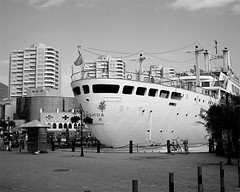
As I look at the four pictures added to this entry, I realize again how difficult it was to see at the Fair. Neon flattened to grey. That has to be where my experience started. In fact, by the second day, I noticed that participating in the Fair not only exhausted me, but also made me irritable. In part, I have placed these photos together to draw out the differences between Fair space and Fat Bird space. However, I also think I have placed these images here, rather than setting them off in a gallery, because they don’t look interesting to me. I think I took these pictures while looking away, rather than trying to see what was there, what might inspire creativity, what might be otherwise.
Six images from found objects were shown at the Culture Fair.
The official site of the 文博会 provides both Chinese and English language news coverage of the Culture Fair. For those looking for equally, but otherwise biased images and information, it’s a good place to start.
shenzhen



 Shenzhen Noted