Advertizing and the Shenzhen Soul


DSCF0704

Originally uploaded by maryannodonnell

The elevators in my building have three walls dedicated to advertizing; the fourth wall, so to speak, is a door. These advertisements change every week. What’s more, the advertisements in each of the three elevators are different. This means that every week, I encountered nine different sales pitches for appliances, cars, cultural events, family phone plans, and beauty makeovers. In short, the walls of my elevator promote a constantly changing version of the good home life, which is presumably affordable to those who live here – the catch is to make these life purchases desirable.

One of the latest advertisements for a beauty makeover claims to be able to remove all traces of acne and pimples. This advertisement disturbs me because its intended audience is Generation 90, teenagers who in addition are under the stress of the gaokao are being told they have no place to hide themselves and feel safe from prying eyes. Given the fact that most adults only notice a teenager when said teenager has blundered, the feeling of an ostrich unable to safely hide its head in the sand is probably spot on, if you’ll forgive the pun.

In English, I have understood the expression “to hide one’s head in the sand” to mean something like “avoid reality” or “avoid the consequences of my actions”. For me, being an ostrich has implied a kind of cowardice and a reluctance to take responsibility. In contrast, this advertisement focuses on being exposed – warts and all – to the gaze of others. In other words, the Mandarin interpretation of “to hide one’s head in the sand” focuses on a response to feeling ashamed – hide one’s face.

In other posts, I have spoken of the difference between lian (face as a metaphor for ethical sensibility) and mianzi (face as a metaphor for prestige and social power), what I hadn’t seen at the time was the way in which the emotional impact of these metaphors is cultivated through reference to actual faces. We effectively use shame to control the behaviors of others not only because we care about ethics, power, and other abstract values, but also because we have been taught to value some faces more than others and in the process become ashamed of our own.

Such is the cruelty of advertizing; it exploits cultural tropes for profit. More lamentably, when successful, the creative minds behind such symbolic manipulation are rewarded for their lack of lian by increased mianzi.

Sigh.
we’ve all done that…

Generation 90, as the teens born after 1990 are known, are reputedly even less socially responsible than the little emperors of generation 80. Not unexpectedly, Shenzhen’s wealthy second generation (富二代) is considered one of the most materialistic and selfish (最功利最自私) in the country. They have all (and yes making absolute generalizations about these teens is a national passtime) bought and then neglected to death goldfish and hamsters and bunnies and turtles; they all engage in competitive consumption, throwing out cell phones and laptops and gameboys as soon as a new model comes out; they all disrespect grandparents, ignore their parents, and only listen to their teachers when they are forced to. As a parent summarized the situation, “There are so many children today with great test skills, but are morally bankrupt (今天的学生功课好,却是个混蛋).”

Like all hyperbole, the stereotypes about Generation 90 carry grains of explosive truth. Most obviously, these stereotypes refer to rich kids, not the children of working families and definitely not the children of migrant workers. The parents of generation 90 think and spend in terms of 10,000s of yuan and not 1,000s (the working class) or 100s (migrant workers). These are kids who only have to face the consequences of their actions should their parents choose not to buy a way out for them. The most egregious examples are all school related: how much parents have spent to get a child into a top school; how much parents have given to a child for getting top grades; how much parents have spent when a child has been caught breaking rules.

In a country where the gaokao structures opportunity, it is easy to understand the resentment that fuels Generation 90 stereotypes. Resentment is further enflamed by the fact that even if these teens don’t test into a famous university, their families can finance a second chance abroad. I also empathize with the nervousness that infuses Generation 90 stereotypes. After all, these teens will hold key positions in the new world order; they are being trained as the next generation of political, military, economic, and cultural leaders and their parents are working hard to make sure that in this new world order China has a strong and respected position.

And yet.

As a child of America’s postwar ascension, I share Generation 90’s conundrum. I was given puppies and hamsters, a top education, and access to key institutions. I was not only allowed, but also expected to make life choices based on desire and personal inclination, rather than on material necessity. My parents also worked hard to ensure that I would have opportunities to learn from, rather than be condemned for my mistakes. I don’t always like or agree with many of the decisions my students make, but I understand how difficult it is to unlearn privilege, especially when it doesn’t feel like anything but everyday life. Moreover, I realize that the wealth and prestige and opportunity that I inherited as part of GenX is the world that Generation 90 is struggling to overcome.

what does it mean to be a foreigner in shenzhen?

Yesterday I was a judge in the semifinals of the First Shenzhen Expats Chinese Talent Competition. An interesting experience both because the event itself expresses the Municipality’s determination to globalize and because it reflects the increasing presence of foreigners in Shenzhen. Indeed, the fact of the event points to the new symbolic visibility of foreigners in Shenzhen and the importance of the foreign to Shenzhen’s official representation of itself both at home and abroad. Specifically, the City organized the Competition as part of a search for a foreigner who can both represent Shenzhen’s foreign community (within China) and be a bridge between China and the World. Thus, who wins and how that winner is marketed will tell us all sorts of interesting things about the changing (or possibly solidifying?) symbolic valence of foreigners in Shenzhen.

According to Paul Shen, Executive Deputy Editor-in-Chief of Shenzhen Daily, which along with the Office to Promote English organized the event, there are now 480,000 foreigners in Shenzhen, excluding Taiwanese and, of course, Hong Kong residents. Half a million foreigners in Shenzhen, at least another half a million Taiwanese and Hong Kongese compatriots, in addition to the previously estimated 14 million Mainlanders in Shenzhen. Parenthetically, we can but hope that the ongoing census will give us some sense of the diversity that actually constitutes Shenzhen.

The eleven competition participants came from Norway, Korea, Russia, Indonesia, Columbia, Ghana, Toga, France, New Zealand, Malaysia, and the United States. Ages ranged from 6 and a half to married with children. Technical skills also varied enormously as the Malaysian and Indonesian participants were overseas Chinese, while the Korean, Norwegian, and American competitors were students in Chinese schools, and the rest were adults who had come to Shenzhen for business purposes and were learning Chinese accordingly.

Now, judging other foreigners’ various levels of Chinese disconcerts me because there are so many standards, most obvious of which might be glossed as technical skills – fluency and accent and control over advanced linguistic patterns come immediately to mind. However, there are also more pragmatic standards to consider. Significantly, pragmatic criteria for determining what constitutes linguistic competence are less measurable than the merely technical; interpersonal skills, cultural competence, and knowledge of appropriate historic contexts are abilities that are differently linked to technical prowess. Most foreign language programs (both in China and the United States) evaluate and test technical skills, while I tend to stress the importance of pragmatic skills, in part because my technical skills aren’t so great (yes, when flustered or angry or excited my tones are even less stable than they are when I’m concentrating), but also in part because the ability to appreciate technical skills itself falls into the cluster of pragmatic talents that differentiate speakers.

I have been fortunate to participate in Shenzhen’s performing arts circle and thus have heard technically excellent Mandarin and Cantonese; with an interest in and translator of Chinese literature, I have also read fabulous poetry and stories. I continue to watch movies and theatre and go to poetry readings in my native English and have preferences and standards for evaluating the quality of someone’s English. All this to make a rather banal point, most Chinese, like most Americans are fluent in their native language, but they are not bards. Consequently, I rarely decide to interact with someone simply because they are competent speakers of English or Chinese. Instead, I make friends based on how and what someone has to say – personality and insight, poetry and conviction appeal to me more than do accent and grammar, even when grammar itself is the precondition for performing personality or expressing opinions.

At the competition, one of the Shenzhen Daily student reporters asked me if I was looking forward to the Universidade next year? Had I been thinking more clearly, I would have answered that I’m looking forward to December’s Fringe Festival and next year’s Architecture Biennial. However, I wasn’t thinking, so I said, “No, because I don’t care about sports.” And that’s my point, however obliquely stated. Nationals from many countries constitute the Shenzhen foreign community. Each of us has different reasons for living here – economic, familial, educational, and personal. That we have emerged as a topic of municipal concern reminds us (again) the extent to which we (all humans, not just holders of foreign passports) do not live merely for ourselves, but rather in and through and for the webs and minds and expectations of those around us. A Batesonian moment this competition: human beings co-evolve and thus how we engage each other is the city – politics in the broad sense of social ecology.

八卦 : gossip and the unfolding of fate

My inner anthropologist wants to set up the following story with theories about the importance of  fate (命) in creating and maintaining moral communities here in Shenzhen; my inner theorist sees how the matrix of Chinese understandings of family, immigration patterns, and rising Mainland wealth are changing possible ways of globalization; my base self just wants to blurt the juiciest piece of gossip I´ve heard in a while. Not unexpectedly, perhaps, I have decided to skip the analysis and take the low road. Ah yes, joys of ethnography qua blog entry, rather than conference paper or refereed publication!

¨He really is unlucky (倒霉 daomei),¨ my friend smirked, his use of daomei (rather than 不幸 buxing) indicating unlucky in the sense of hapless or pathetic, more the clown than hero of fate.

¨Spill the bagua,¨ I invited. Ba gua (八卦) are the eight hexagrams and the central element of divination in the Yijing. However, the phrase ¨spill the bagua (八卦一下)”means spill the gossip, in all its delicious forms, but most precisely, romantic gossip – who´s hooked up, who´s getting married, and, of course, the results of all this fooling around. This is important, yes, bagua is gossip, but it is also a story about how a human life is destined. Thus, as with daomei, language choice highlights the role of destiny in shaping a particular life.

Well, it turns out that friend Daomei´s girlfriend is an overseas Chinese, second generation sent back to the Mainland to learn Mandarin. The two hooked up and seemed to be enjoying themselves when girlfriend found herself pregnant. She went home to talk with her parents to figure out what to do. A while later, girlfriend returned with parents to talk with Daomei about getting married. Of course, Daomei hadn´t told his parents that he had a serious girlfriend so the parental introduction was awkward. Daomei´s father asked if Daomei was ready to take on the responsibilities of a family.

¨Yes!¨

The next question then was where the two would live. Girlfriend wanted to stay in the Mainland, so Daomei and his father went about buying a house and finding a more or less stable job for Daomei. Meanwhile, girlfriend and parents flew home to prepare to move to China. However, not long afterward, Daomei received a phone call.

¨I think we should live overseas.¨

¨What will I do abroad? I don´t even speak English that well.¨

¨Don´t worry about that. Lots of Chinese abroad don´t know why they´re here; it´s just a question of adjusting. Anyway, my father found you a job and an English program.¨

So, Daomei´s father sold the house and gave the money to Daomei to immigrate and start a new life abroad, ¨After all, son,¨ he said, ¨the money is yours to start your married life.¨

However, even as Daomei began his immigration paperwork, girlfriend miscarried. A second phone call.

¨We lost the baby.¨

¨What about us?¨

¨I need some time to xiangyixiang (想一想 ),¨ she said, indicating her decision to reevaluate the relationship. However, xiangyixiang is a weak expression; we also xiangyixiang about where we want to go to dinner or spend a holiday. All sorts of words might have been conventionally more appropriate – kaolv (考虑) or fanxing (反省), for example. But xiangyixiang it was.

So, Daomei went to his father, returned the money for safe keeping and asked, ¨What´s your next step?¨ The implication being, this is your chance to make a clean break and get your act together.

Daomei answered, ¨I think I need time to xiangyixiang, too.¨

His father sighed, clearly having hoped for a more resolute next step and said, ¨You do that. However, I´m not going to take care of (管 guan) planning your next wedding.¨ And guan as we know involves taking responsibility to insure the best possible result. In many ways, guan is the antidote to the slings and arrows of outrageous fortune – it is the human commitment to have things unfold according to a righteous plan. Think Pontius Pilate washing his hands of the decision to execute Jesus of Nazareth as an example of the resignation in Dad´s decision not to guan Daomei anymore; I have done what I can and can do no more.

The friend who shared this bit of bagua with me concluded with the comment that ¨The parents are really innocent (无辜 wugu),¨ and by implication had been wronged by fate.

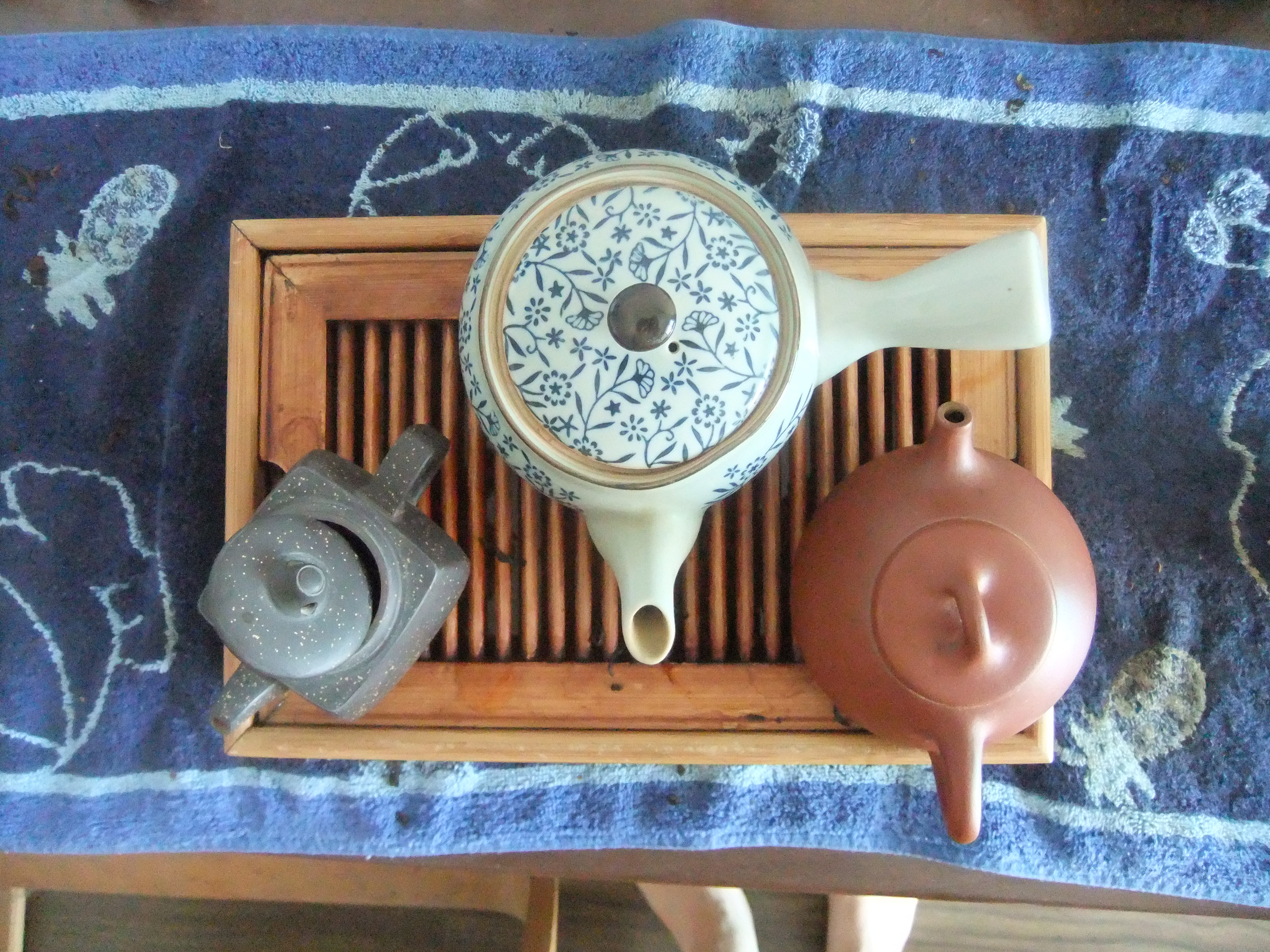
teapot chinese lessons

teapots remain some of my primary texts in learning mandarin. yesterday, for example, yang qian asked me which teapot i wanted to use. i answered, ¨the red one.¨ he laughed. why?

it turns out that the conventional order of description in mandarin would have been: the material the teapot was made of (clay 紫砂的 verses porcelain 瓷的), size (large 大的 versus small 小的), shape (round 圆的 versus square 方的), and only then color (black 黑的, red 红的, and blue 蓝的). so i could have asked for the ¨big clay pot¨ or ¨the round clay pot¨. he pointed out, with other items, such as a table top, texture (smooth 平的 versus 不平的 ) would have been more salient than color.

yang qian then posited that the ancient greeks understood the world through vision, while the chinese understood the world through tactility. consequently, our respective languages (off shoots of languages no longer spoken or even written) organize the world differently. i see color first, where he ¨sees¨ materiality.

in addition to learning to rephrase my requests, i´m not sure where to head with this. metaphors we live by (linguistic anthro 101) has remained one of my favorite books about language acquisition through increasingly abstract processes. default categories are more or less universal (tree, cup, pot) because we can touch them, but more specific and more general categories are shaped by culture (specific tree names and relative familiarity with said trees).

caveat aside, i´m now thinking about the cultural organization of pleasure. i´ve heard various arguments that chinese civilization has been traditionally more hedonistic than western. i have tended to interpret these arguments as projection of the ¨what i want my life to be, but isn´t, so i see that life in country x¨ variety of insight. but, it is interesting to contemplate that pleasures might be focused through different senses. and i find it even more interesting to think about how careful attention to everyday requests and descriptions might map entry into those other worlds.

yes, teapots bring all sorts of joy.

anxious masses: Thinking about Gu Wenda´s Ink Alchemy

Yesterday at the opening for experimental ink artist Gu Wenda, I was struck by the unfolding of scale in his work. His early work could be completed by one person. There were large paintings, like Surreal Horizon (超现实地平线) or images from Lost Empires (遗失的王朝) but nevertheless the actual works themselves conformed to a human-sized world as I have come to know it. I felt myself and the art to be at the same scale. Indeed, often I was larger than the pieces and some, like the Red Heart Series (红心系列) of seals on small, abstract ink paintings, I could hold in my hand. However the later work, such as the Ink Alchemy Series (水墨炼金术系列 – above image) was large scale industrial. As such, these pieces could not be completed by any one person or even by a group of people working with their hands. Instead, the artist became both an industrial designer and an organizer of human labor and machines over time.

Made entirely of died braids of human hair, Gu Wenda’s most recent installation Black Gold (黑金)  fills the entire OCT Art Terminal. In the middle of the cavernous room, a large rectangle of ink powder lies flat beneath a canopy of black braids. To the left and right of the canopy, evenly spaced sections of died braids hang from ceiling to floor in fine, delicate loops. The installation is deceptively simple – blocks of color shimmering neatly beneath gallery lights. However, Black Gold took three years (2008-2010) to complete and thinking about what would be necessary to complete such a project left me feeling both frightened and exhilarated. Frightened because I imaged thousands of woman, who had given several years of their lives to grow their hair, scalped to make an epic statement. Exhilarated because the level of coordinated precision needed to execute Black Gold spoke to me of how one might go about representing Chinese society – massive blocks that from a distance seem a well-organized whole, but which upon closer inspection dissolve into idiosyncratic anonymity.

Neatness or tidiness (整齐) of large groups or objects is one of the mass aesthetic values that I have had difficulty appreciating. Not that I don´t enjoy watching several thousands of people making the same motion at precisely the same time, but when I think about the level of work that is necessary to achieve such precision, I feel the same anxiety that I felt upon seeing Black Gold. Several examples of mass coordination come to mind: military marching, classrooms full of Chinese students taking tests over and over and over again to prepare for the gaokao, highways full of cars, miles of grazing pasture in the American West and wheat fields in the Mid. Massive, national bureaucracies. Each of these instances of mass coordination exemplifies the human potential to submit to external hierarchies that take sameness and repetition to be the signs of unity and belonging.

And here´s the rub: one what?

Military marching and mass test-taking provide living metonyms for the modern, industrial state. Nevertheless, these mass exercises also remind me of feudal traditions, in which being born into oneś place enabled large societies to hold their form for generations. In other words, for many to become one, for each to find her ¨place¨ takes a lifetime of practice. This taking one´s place in a larger order is natural insofar as to be human is to belong to various groups of various sizes. Indeed, as far as I can tell, this is the whole point of education – helping young people figure out how to inhabit diverse sets of coordinated relationships.

The anxiety I feel when thinking about Black Gold, specifically and mass coordination, more generally has to do with the means and goals of mass practices. Military marching, mass test-taking, driving on the highway, planting acres of wheat: each of these practices takes an abstract idea of what it means to be human and imposes it on the diversity of the world, creating conditions of idiosyncratic anonymity. Moreover, these practices aren´t particularly healthy. Armies go to war, Chinese students become test-taking machines, carbon monoxide kills as do the pesticides necessary to maintain wheat fields.

In contrast, if there is such a ¨one¨ out there, I’m Buddhist enough to believe that the point is to create conditions of mutual recognition. Creative collaboration rather than mass coordination, so to speak. I’m not sure what this means in terms of reorganizing nations or highway systems or college entrance requirements. Yet I trust the process. When I take the time to understand each of my students, something happens between us. And that state of sharing between – elusive, delicate, and quite beautiful – could transform mass culture in unexpected and wonderful ways.

Gu Wendaś Ink Alchemy retrospective is currently up at the He Xiangning Museum of Art and the OCT Contemporary Art Terminal. Worth a visit.

what is a self introduction?

I want to talk about the cultural work of self introductions, a topic one would think I had actually given some thought to, but alas, no. However, yesterday, insight. And yes, long story short, I’ve been all too American in how I introduce myself for way too long…

This past weekend, I was in Meilin at the Art de Vivre Art Space (圆筒艺术空间) to participate in the workshop stage of the second Coaster Raid, a series of events organized to promote creative exploration of Shenzhen. During the workshop weekend, nine creative groups or individuals met to explore Meilin and come up with artistic interpretations of the space literally at Deng Xiaoping’s back. On October 31 at 19:00, we will reconvene to show our work to the public. The showing is free and open to the public and the riptide team  hope to encourage reflection on and debate about the city. They are particularly interested in generating fresh approaches to seeing, representing, and talking about Shenzhen.

Yesterday, to conclude the workshop weekend, we had a more or less formal presentation of our ideas, so that the discussion could be recorded. The format was simple: riptide organizers, Michael and Gigi asked participants four questions and participants responded. The first question was: Why did you come to the event?

The Chinese participants all indicated they had been invited by Feng Yu, the Meilin organizer of this Coaster Raid. Some even indicated that they had accepted precisely because they knew Feng Yu to be an interesting person and that anything he was involved in was bound to be interesting.   I said that I had come because I had been exploring Shenzhen for 15 years and was thrilled to have the chance to explore with a new group of friends.

As the introductions went on, it became clear (to me) that the Chinese participants were taking self introduction as a chance to delineate the relationships that had brought them to this moment and only then did they begin to describe their projects. Indeed, as far as identifying themselves within the group, I had a strong sense that for the Chinese participants the relationships that had brought them together were more important than their work. In this sense, the common thread that they had come “to play (玩)” makes perfect sense. In contrast, I assumed that I had been invited because of my work and accordingly, an introduction to my work was the point of the self introduction.

I’m wondering if the difference in emphasis, Chinese participants on relationship, American moi on work works to creates misunderstanding even before conversations begin. To my English speaking heart, the Chinese introductions sounded vague and somehow off the point. Similarly, I wonder how arrogant or self-absorbed my self introduction sounded to Mandarin speaking hearts. I asked, but was reassured that, “Your Chinese is excellent.” And me thinking, “Yeah, but my social skills. What about my social skills?”

So now, I’m thinking that it might be useful to listen attentively to self introductions because they elucidate how my interlocutor perceive the purpose and direction of our interactions and, more specifically, collaboration in Meilin. I’m wondering to what extent my Chinese colleagues understand their work to be a means of exploring and strengthening, sometimes testing our various relationships. Indeed, this way of thinking points to the idea that how well and hard someone works becomes an expression of care or respect. It also allows for the possibility that any meeting may blossom into long term and deep friendships and yes, most Chinese self introductions include a variation on the phrase “I hope we can all become friends.”

In contrast, I know that I’m a good collaborator because I come for the work, whether or not it leads to stronger relationships. Thus, at first Chinese glance, I must appear to be committed to relationships, friendly, and conscientious. However, I know that my relationships may come to appear instrumental because once a project is finished, its easy for me to move on to the next work organized set of relationships.

Hopefully, as I wander through Meilin alone and with companion participants, I will learn to balance my impulse to work for the work with an attention to the work of friendship.

Tea Party 道理

Brief contextualization of conversation with cabbie (sept 3) about 利 (benefit) and good governance.

One of the classical references to why going after benefit is not good governance comes from Mencius:

孟子见梁惠王。王曰,叟不远千里而来,亦将有以利吴国乎。孟子对曰,王何必曰利,亦有仁义而已矣。王曰何以利吴国。大夫曰何以利吾家。士庶人曰何以利吾身。上下交征利而国危矣。万乘之国,弑欺君者,必千乘之家。千乘之国,弑欺君者,必百乗之家。万取千焉,千取百焉,不为不多矣。苟为后义而先利,不夺不厌。未有仁而遗其亲着也。未有义而后其君者也。王亦曰仁义而已矣。何必曰利。

Rough translation with my glosses (so yes, if you have questions, check out another translation):

Mencius met with King Hui of Wei. The King said, “I don’t think 1,000 miles is too far to go if it benefits my kingdom.”

Mencius replied, “Why does your Majesty mention 利 (li – benefit) when all that is needed is benevolence and righteousness? When the King speaks of what benefits the kingdom, then officials speak of what benefits their clans, and nobility and commoners speak of their personal gain. When superiors and inferiors are struggling to obtain 利 then the kingdom is endangered. It is the clan of 1,000 chariots that kills the king of a 10,000 chariot kingdom [because the king took too much and gave nothing back]. It is the clan of 100 chariots that kills the king of a 1,000 chariot kingdom [because the king took too much and gave nothing back]. Taking 1,000 from 10,000 or 100 from 1,000, neither can be considered negligible [when the king gives nothing back]. Thus, when gain comes before righteousness, then none are satisfied until they’ve wrested the gain for themselves. Only when benevolence is established are there [proper] families. Only when righteousness is established is there a [proper] king. Why speak of 利? [Why make benefit the reason for your government when it should be benevolence and righteousness?]

In other words, we (in both the US and China) find ourselves in a state of tea party hegemony. It’s not the poor who rebel – taxi drivers and farmers who are satisfied with enough to eat, but rather the upper middle class who thinks the government is taking too much in taxes and not giving enough in return. The fact that Sarah Palin and her ilk have missed the point of the Boston Tea Party (equitable representation in government in order to fairly allocate common goods) does not mean they haven’t touched a populist nerve: the people do feel overtaxed relative to the good (benevolence and righteousness) that the government administers.

All this to say, Shenzhen cabbies have a remarkably clear eye for what’s wrong with the US because they see what’s also wrong with China.

value is what we make of it

Fun conversation with a cabbie this morning. We began with why is the US going into Iran if we’re pulling out of Iraq. After I said something about Americans having few alternative models of foreign policy, he said accusingly, “You Americans only do these things when it benefits you.”

I asked if there were reasons other than profit/benefits (利) for governments to do anything.

“Of course not.”

“So,” I countered, “Why is the PLA in Xinjiang and Tibet?”

And here’s where the conversation veered past the usual historical blah blah blah. Instead, the cabbie agreed knowingly, “There’s got to be something. You do realize that Xinjiang produces the highest grade cotton in China?” he asked me.

The cabbie came from Hubei and his family was cotton farmers. Apparently, Xinjiang produces the highest grade cotton in China because of the dry climate. In contrast, Hubei cotton must be harvested as soon as it blooms, otherwise one rainstorm will ruin it. So it stood to reason that the Chinese government is investing so much in Xinjiang for the cotton.

Cotton. Oil. The US and Chinese governments didn’t seem so very different at that moment. I commented that it was hard to be one of the people (百姓).

He laughed said, “If Chinese farmers have enough to eat, we’re okay, but now we can’t even trust our food.”

Taxi cab politics at its best.

30th Birthday Party Countdown

The countdown for Shenzhen’s official 3oth Birthday (26 August, 2010) has begun. All sorts of events are planned at every level of government, including a three-day weekend for white collar workers (27 Aug will be a municipal holiday). My favorite event is the mass give away of phone cards (15 million!) so that every Shenzhen inhabitant can reconnect with loved ones back home and “introduce them to 30 years of success in the Shenzhen Special Economic Zone (quote unquote from the front page of 深圳特区报:“发放专门制造的纪念电话充值卡,可以让市民打电话向亲朋好友介绍深圳经济特区30年的建设成果”)”

It’s true, the story of cell phones and Shenzhen identity needs to be written. Not just in terms of individual identity (keeping connected, texting all sorts of jokes, and unofficial rumors, letting a child play games while parents chat at morning tea), but also in terms of the way that the City has used cell phones in soft propaganda campaigns. What’s more, phone statistics seem to be the most accurate way of estimating Shenzhen’s population and demographics.

Also of note is the celebratory language. Other than the obvious resurgence of earlier reform phrasing (特区 this and 特区 that has returned with a vengeance, and 闯 is once again the verb of choice to describe the act of immigrating to and inhabiting Shenzhen), City officials and public intellectuals are appropriating Confucian understandings of proper aging.  Shenzhen is celebrating: 三十而立 成就深圳 (at thirty one establishes herself; successful Shenzhen). Likewise, the next ten years are being discussed as a movement from 三十而立 to 四十而不惑 (at forty one has no doubts / hesitations).

And finally, just a note on polysemy and how the mind wanders. One of the front page articles for the celebration kick-off was: 发挥党代表作用,增强党的活力. At first glance, the phrase means what it says: make full use of Party representatives, strengthen Party vitality. However, in colloquial slang, when one man joins a group of women, that lone man is called 党代表 or Party Representative. So, instead of thinking good thoughts about how the Party is still striving to improve itself, I’m thinking that those Party representatives do need to keep their strength up!