临摹:When is a copy not a copy?

This November, I was an assistant for the OCAT international art residency program, through which I met artists Frank Haermans and Thomas Adebahr, the artist collective of Nika Oblak and Primoz Novak, as well as curator Paula Orrell. Together, they put up the show Future Relevance, or as we translated it “明天,谁说了算?”

Interacting with the artists and curators was interesting because it inspired me to think differently about my own forays into creative ethnography and forms of representation that engage different (and frankly) wider audiences. In particular, Thomas Adebahr’s earlier work, The Benjamin Project (shown at Gallery Diet) had me thinking about contemporary art conventions that value some forms of copying and reduce other forms to “labor” albeit “skilled”. The question, of course is: how do we move across and between these social structures to create meaningful dialogue about human creativity? Continue reading

Christmas thoughts

This Christmas, while wandering through spaces decorated for Christmas parties and romance, I realized that in Shenzhen, Christmas is a night of countdowns and parties  because folks here think about Christmas as “western new year”. My Chinese friends and many others use associated festivities as means of making new intimacies, rather than confirming old intimacies, which is what they do at Chinese New Year’s. So last night, there were Christmas parties, romantic dinners, and declared intentions; today, I will go to a spa with friends and then have dinner at another friend’s house.

I’m not sure how many圣诞节s I have now spent in Shenzhen, however, I remain both dazed by interpretations of how Christmas might be celebrated in the total absence of religiosity and also overwhelmed by the kindness people have shown me because they know how hard it is to be away from family on days when we remember and assert intimate belonging. Alas, it is far too easy to reduce Chinese Christmas celebrations to another excuse to sell decorations and presents that didn’t get shipped to western markets, especially, when less than ten years ago people were still asking me which was more important, Christmas or Halloween? Nevertheless, today, I’m remembering that any shared holiday potentially exceeds our cynicism and yes, offers the chance of mutual redemption precisely because we gather.

Happy holidays.

意maging baishizhou

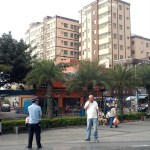
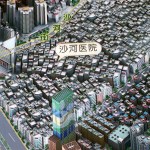
Three pictures of the northeastern corner of Baishizhou along Shennan Road. The map and detail are from a map in the Window of the World subway station, the third is a photo of the actual corner, taken from the plaza in front of 沙河世纪假日广场 (Shahe Century Holiday Plaza), the large landmark in the two maps. The contrast between the map and the territory interests me because it the ongoing (re)imagineering of Baishizhou in particular and Shenzhen more generally.

Baishizhou, as mentioned in earlier posts, is one of Shenzhen’s more “chaotic (乱)” urban villages. However, it occupies prime real estate – directly across from Window of the World and on the Line 1 Subway. Consequently, upgrading Baishizhou is an ongoing project and has included major real estate development. Tellingly, most information about Shahe Century Holiday Plaza real estate (herehere, and here, for example) emphasizes the subway convenience, views of Window of the World, and modern amenities, downplaying and often ignoring the Plaza’s neighbor, Baishizhou.

Continue reading

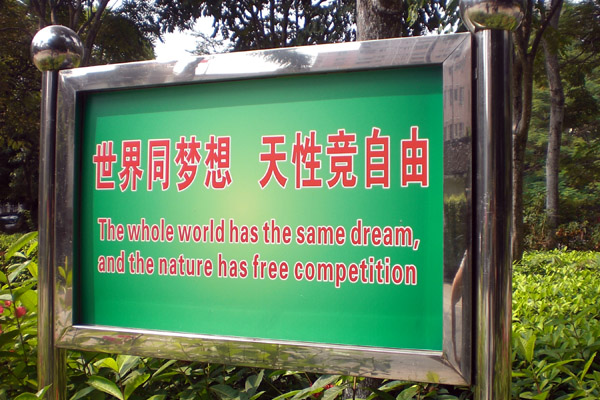
Translation question: 天性竟自由

I’m having difficulty figuring out what this sign actually means. Clearly, the English is off. My sense of the Chinese, however, is to attribute all sorts of neoliberal interpretations to the line 天性竟自由; no matter how I cut it, I come up with a slice of economic pie. Nevertheless, I recognize that there are important nuances even within forms of neoliberal essentialism. Hence my question: How would you translate this sign? Please share translation and rational.

RIP – Steve Jobs and neoliberal immortality


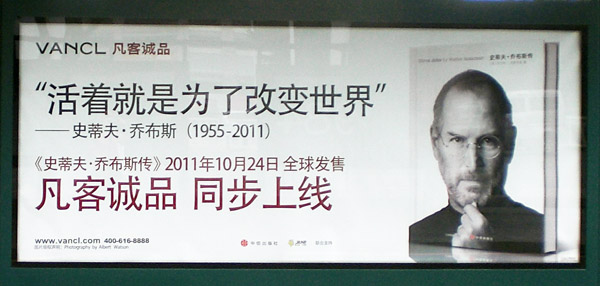
A recent advertisement for VANCL web quotes and shows a book about Steve Jobs. My first reaction was disgust: how is it possible to use someone’s death as a means of pushing goods? However, my random sampling of Chinese friends shows that there is another way of understanding this advertisement – social immortality or 不朽 (buxiu), which means that you continue to influence the world even after you have died. All agree, Steve Jobs achieved buxiu.

According to my friends, who don’t believe in an afterlife but do believe in continuing influence, Jobs achieved buxiu through three forms of social memory: 立功 (establish work),立言 (establish language),立德 (establish morality). 立 means to stand-up or to establish. 功 is a wonderfully rich character that has (at least) five meanings: merit, service, result, achievement, and accomplishment. 言 means language or speech and 德 refers to virtue. In other words, buxiu consists in setting up an institution, being cited, and setting moral standards. Steve Jobs’ accomplishment was to establish Apple, his speeches and citations now circulate on the internet and people learn from them, and his morality was to achieve brand confidence; Apple products are neither counterfeit nor substandard; their virtue as products is guaranteed quality.

Thus described, the kind of buxiu that Jobs has achieved seems classically neoliberal and begs all sorts of questions about how and why we are busy commodifying every aspect of our lives and afterlives. Indeed, we are clearly using economic metaphors to organize how we treat the living and the dead. How else to understand a world where trust can refer to forms of human relationship that have been structured by multi-generational financial arrangements? Consequently, talking about Steve Jobs and VANCL in Shenzhen reminded me of yet another cross-cultural capitalist truth; there’s as much honor and respect attached to VANCL’s use of Steve Jobs to promote online shopping, as there is when his American compatriots link the price of Apple stock to his passing.
what does it mean to say, “我不反对”?

On the face of it, the situation was quite simple. A Shenzhen museum had promised a group of foreign artists that they would hold an exhibition for work completed while in Shenzhen. However, because the Biennale has occupied the better gallery spaces, the question the group faced was, “Where should the exhibition be held?” Finding an answer to this question entailed too many conversations and frayed nerves. Why?

Simple answer: because saying “yes” seems to be easy in either language, but saying and accepting “no” gracefully are tricky in one’s native language, let alone cross culturally.

Longer answer: Professionals, both Chinese and Western, often find ourselves talking at cross purposes because we think we know what we are saying, especially when negotiating consensus on how a project should move forward. Continue reading

突破:what is a break through?

Lately, I have been thinking about how each of Shenzhen’s six officially lauded break throughs appears as an instance of slogan warfare. Concomitantly, I have thinking about creative destruction, both Marxist and neo-liberal variants. Roughly speaking, Marx defined creative destruction as the necessary destruction of property and means of production (including social relations) so that new wealth could be generated. In contrast, neo-liberal economists like Joseph Schumpeter have tended to define creative destruction in terms of innovation. A question of emphasis that also beats at the heart of moral value: Marx witnessed destruction and its fallout; Schumpeter saw innovation and its benefits.

So below, a brief survey of Shenzhen breakthroughs to track the shift from socialist to neoliberal political morality. As Marx and Schumpeter indicate, none of these break throughs have been morally neutral, legitimating both new forms of inequality and opportunity. Continue reading

historic ironies: the fanshen metro station, shenzhen

Fanshen is one of the recently opened Baoan District subway stations. Like Daxin (in Nanshan), Fanshen was the name of one of the Communes in Baoan County and now refers to the general area where commune headquarters once stood. Literally, 翻身 (fān shēn)means to turn over. In the context of the Chinese Revolution, fanshen referred to the liberation of peasants from feudal obligations by transferring rights to land and draft animals from local gentry and rich peasants. Fanshen: A Documentary of Revolution in a Chinese Village by William Hinton remains one of the best introductions to the reasons for and implementation of Maoist land reform.

Along Fanshen Road, I also stumbled upon Anle Second Brigade New Village (安乐二队新村), a place name that melds traditional values (安乐 means peace and happiness), Maoist production (小队 small production brigades based on village divisions), and early Shenzhen reforms (新村 new villages were the first local incarnation of the household responsibility system; only as urban area spread to surround them did new villages become “villages in the city (城中村)”). Continue reading

naked marriages; stripped at divorce

I’ve recently heard the phrase 羡慕妒忌恨 (envy covet hate) to refer to situations where another is happy in a situation that shouldn’t make her happy. For example, someone with a full-time job might envy-covet-hate a part-time worker who is happy with her situation – free time, low stress job, low pay, few high-priced objects. The point, of course, is that those with “everything” the new economy has to offer – prestigious jobs, upscale homes, and fancy cars – aren’t happy and thus envy-covet-hate someone who feels happy with her life. In Mandarin, this deep sense of satisfaction / contentment / happiness is called 幸福感 and friends are quick to point out, published accounts notwithstanding, Shenzhen has one of the lowest happiness indexes in China. Continue reading

原创-the sz cultural industries fair

The Seventh Shenzhen Cultural Industries Fair (文博会) opened three days ago. Of note is the ongoing institutionalization of types of creativity; by Hall theme, various Shenzhen ministries recognize and promote the following types of cultural industry:

  1. Integrate Culture and Science and technology, Advance Industry and Market Development 文化与科技相融合,产业与市场相促进
  2. Creativity, Taste, Life 创意 • 品味 • 生活
  3. New Media, New Life, New Future 新媒体 • 新生活 • 新未来
  4. Inheritance, Craft, Products, Preservation 传承•技艺•产品•保护
  5. [No Hall 5]
  6. Design, Branding, Quality 设计 • 品牌 • 价值
  7. News Publications 新闻出版馆
  8. Culture, Collision, Exchange 文化·碰撞·交融
  9. Creativity, Challenge, Going Beyond 创意·挑战·跨越

Continue reading