anthropologizing

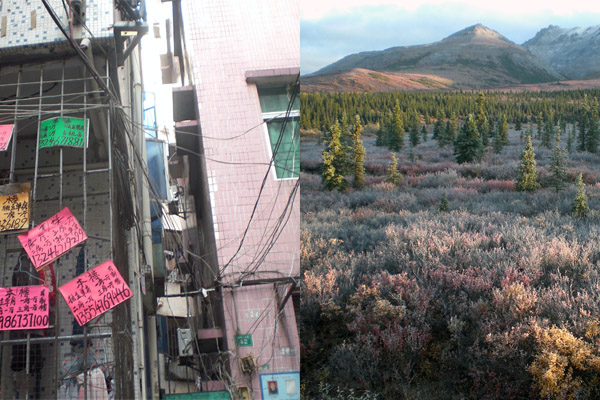
So, a juxtaposition of Baishizhou and Denali, which may be achieved through visual flattening, but as lived required movement through time and space — from Shekou to Hong Kong international by way of Shenzhen Bay checkpoint to SeaTac and then on to Anchorage and passage on the Alaskan Railroad.

I look at snapshots taken here and there, searching for commonalities, for what we might call human universals, which Donald Brown has defined as “those features of culture, society, language, behavior, and mind that, so far as the record has been examined, are found among all peoples known to ethnography and history.”

There is, of course, the eye of the beholder — mine — which seems drawn (here, at least) to pink, but all this does is raise the question of whether or not what I experience in each of these places is what other people also experience. In Chinese poetics, this common — unquestionably and recognizably human — response would be called yijing (意境), which literally means “idea scape” and denotes the moment of union between interior and exterior states of being.  意, for example, is composed of characters meaning “sound (音) and heart (心)”, while 境 is composed of characters for “earth as soil or land (土)” and “final or complete (竟)”, which here functions as a sound marker for jìng.

What are the respective yijing‘s of Baishizhou and Denali? And can we confidently generalize our responses to say, “Just so and how could it be otherwise?”

These questions matter because both Baishizhou and Denali are the focus of conservation efforts, albeit of a different ilk. Both discussions assume a common response to a particular environment. Moreover, in both discussions, one’s response to the environment is taken as an expression of one’s humanity and there, of course, is where the debate rages.

At Baishizhou, the current discussion of how to raze and rebuild an urban village focuses on the experience of mass urbanization and the need for access to housing, food, and transit networks. The debate has two assumes. First, the debate assumes that inequality is a defining feature of human life and that the purpose of social life is to ascertain that level and take measures to insure that people do not live in inhuman conditions. In turn, the content of the debate is over where to draw the line between human, subhuman, and inhuman living conditions. Second, the debate also assumes that urban living is a desirable form of life because it results in access to cultural goods, such as medical care and education by way of intentionally crafted environments, such as hospitals, schools, restaurants, and entertainment districts. As debated, these two assumptions are hierarchically ranked into the Maslovian categories of “basic needs” and “higher needs”. Thus, as one debates, one is not simply drawing lines between this life and that, but also and more importantly, revealing one’s humanity as a function of social responsibility.

Likewise, at Denali a general assumption and its implementation shape debate, but here over the nature and value of wilderness. On the one hand, the debate assumes that the experience of wilderness reveals and cultivates the wild, untamed spirituality that makes us human and that the purpose of social life is to maintain and create spaces where people can realize this spirituality. In turn, one’s love of wilderness functions in this debate as a marker of one’s spirituality. On the other hand, the debate also assumes that wilderness occurs in the absence of human settlements, such that in order to build human settlements one must transform wilderness. As debated, these two assumptions are also ranked hierarchically in terms of what is essentially human (nature) and acceptable transformations of wilderness (culture). Thus, as one debates, one is not simply drawing lines between this life and that, but also and more importantly, revealing one’s humanity as a function of wild spirituality.

It is possible to note the Chineseness of the Baishizhou debate (all that Confucianism going down), just as it is easy to remark on how much Emerson and Muir continue to shape American understandings of our place in the world. And therein lies the challenge of cross-cultural debates about what it means to be human in a world where Baishizhou and Denali cross paths, so to speak. The question is not so much either / or — which is a more accurate definition of what it means to be human: social being or wild spirituality, but rather the question seems to be: what might the Baishizhou debate teach us about the cultural place of wilderness, and what might Denali remind us about the limits to human settlements?

CZC Special Forces

Am collaborating with a multi-national group of architects, urban planners, and concerned citizens to jumpstart an effort to renovate the Tangtou section of Baishizhou. Yesterday, at one of the Design Center’s Cool Tea (酷茶) events, I gave a short presentation on our four meetings to date and an introduction to sociocracy, the form of governance we are attempting to set up. The talk was well received, especially the discussion of how to run a meeting.

I have recently realized that there is not only desire to transform Chinese society, but also many such salons and talks springing up all over Shenzhen. Significantly, the terms of the discussion are the built environment. Last night, for example, the first talk by the Shenzhen Green Building Association charted the expansion of government sponsored discussions about environmental standards — their group has several hundred members and they are quite active. SGBA seems to be moving in the direction charted by Wang Yang in his recent address to the Guangdong Party and one of their core ideas is happiness index (幸福指标). As mentioned in an earlier post, Wang Yang has defined happiness in neo-liberal terms: a feeling of personal well-being brought on by doing what one likes to do. Upside, this definition leaves space for heterogeneity. Downside, it justifies all sorts of social neglect and individual appropriations of common resources. Nevertheless, the point remains: Shenzheners are talking about what it means to inhabit the city as members of a society AND the discussion is being coded in architectural and urban planning terms.

A copy of my talk (in Chinese), here; the accompanying bi-lingual powerpoint, here.

The Value of Urban Villages

US American real estate developers chant, “location, location, location.” In Shenzhen, primary locations open for development are actually urban villages slated for old village renovation — redevelopments that involve the final transfer of village held property to the Municipality.

In a Jingbao article on the future of Nanshan District, Li Xiaogan, recently appointed Nanshan District Secretary, noted for example, “In constructing a global district and promoting urban renovation, Nanshan District will have several advantages over the next few years. First, the largest urban renovation project in Guangdong Province – Dachong Urban Village, with a total project area of 683,000 square meters; second, the urban renovation project for the five villages of Baishizhou in Shahe, which is currently being planned, also has an area of over 650,000 square meters, and is again one of the largest in the Province; third, located in the north of the District, the three Shuiyuan villages are within the water conservation and ecological conservation red lines, and are thus relatively backward, however, they are also now in the planning stage of development; forth, the old Xili Market, which we are planning to convert to an urban complex; fifth, the banks of the Shahe River, where we will take international bids to create an ecological cultural corridor, and; six, Nanshan Old City, which with everyone’s support we hope to return to its status as Shenzhen’s historical and cultural root, by resituating all residents and completely rebuilding.”

Recent impressions of Baishizhou, below:

This slideshow requires JavaScript.

意maging baishizhou

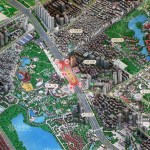
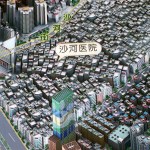
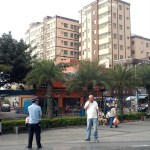
Three pictures of the northeastern corner of Baishizhou along Shennan Road. The map and detail are from a map in the Window of the World subway station, the third is a photo of the actual corner, taken from the plaza in front of 沙河世纪假日广场 (Shahe Century Holiday Plaza), the large landmark in the two maps. The contrast between the map and the territory interests me because it the ongoing (re)imagineering of Baishizhou in particular and Shenzhen more generally.

Baishizhou, as mentioned in earlier posts, is one of Shenzhen’s more “chaotic (乱)” urban villages. However, it occupies prime real estate – directly across from Window of the World and on the Line 1 Subway. Consequently, upgrading Baishizhou is an ongoing project and has included major real estate development. Tellingly, most information about Shahe Century Holiday Plaza real estate (herehere, and here, for example) emphasizes the subway convenience, views of Window of the World, and modern amenities, downplaying and often ignoring the Plaza’s neighbor, Baishizhou.

Continue reading

baishizhou

Sunday afternoon in Baishizhou – sunlight, children playing, and fresh markets.

This slideshow requires JavaScript.

tangtou, baishizhou


tangtou old housing, new village

Baishizhou has the distinction of being Shenzhen’s “city that isn’t a city, village that isn’t a village (城不城,村不村).”

The first stop (bus or subway) after Windows of the World themepark, Baishizhou has come to refer to a 7.5 sq km sprawl of handshake buildings that was originally part of the “Shahe Overseas Farm (沙河华侨农场)”. This highly congested and irregularly built area is also the first stop for many new migrants to Shenzhen because of its central location, convenience, and lowest of the low priced housing.

Inquiring minds ask, “How did (one of) Shenzhen’s most beautifully landscaped high end residential, tourist and arts area (OCT) end up next to what is acknowledged to be one of the city’s largest slums?” Continue reading