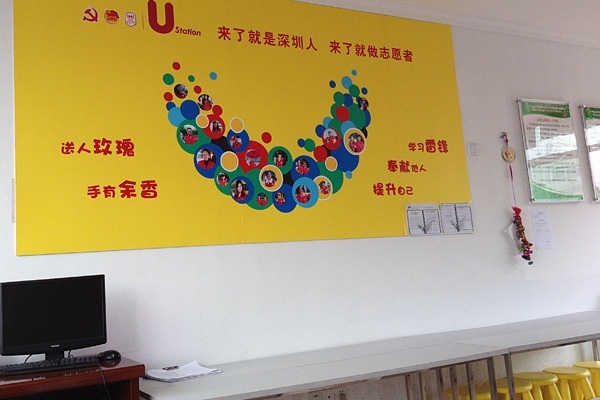
In the Summer of 2011, Shenzhen hosted the Universiade. At the time, we complained about the face projects and cost there of. In retrospect, it seems, however, that one of the more lasting effects of hosting what is basically an Olympics for college students was that volunteerism and u-stations took root and flourished.
U-stations can be found throughout the city, and are staffed by young friendly and sufficiently bi-lingual folk, who hand out bike maps to the city and introduce nearby attractions. All wear the highly recognizable Shenzhen volunteer vest. In fact, this new emphasis on volunteer citizen participation may also have contributed to an interesting renaming–Shenzhen migrant workers are now officially called “those who have come to build Shenzhen”. The phase reworks the Shenzhen volunteer slogan, “if you come, you are a Shenzhener”. The Chinese wordplay is from 来了就是深圳人 to 来深建设者.
Several days ago, I met with the director of the Baishizhou Culture Center. We spoke in a comfortable, well lit library which was also a u-station! Other programs run by the Center included an after school program, which is staffed by those young and friendly red-vested volunteers. We were in the station to talk about opening a community learning center under the auspices of this collaboration between multiple levels of government. We would be another NGO sponsored by some level of government to work in Baishizhou.
This is where the administrative structure gets interesting. The culture station is housed in the Baishizhou Five Village corporation, which represents locals’ interests and manages Baishizhou properties, electrical, sanitation, and other municipal services. However, the culture station is funded by the street government, which is responsible for implementing district policy. The volunteers are a municiple level NGO.
So here’s the a-ha moment: u-stations and volunteers have permeated even urban village regulatory structures and may have an important role in redefining citizenship and the role of the city in financing not-for-profits.
 Shenzhen Noted