fun with cell phones

it has taken me a while to appreciate cell phones. at best, i find the use of cell phones disconcerting, as when people walk down the street in conversation with invisible interlocutors. at worst, i find them intrusive and an excuse for poor manners. i especially detest texting messages, a practice that many of my friends pursue with gusto.

lately, however, i find myself unexpectedly charmed by the cell phone. as with e-mail, folks forward jokes and other bits of information to those in their calling circles. it turns out that some of the jokes are not only genuinely funny, but also bitingly satiric. like rumors, these anonymous messages are not factually true, but instead capture something of the ethos of an era. indeed, the humor seems to stem from hyperbole. nothing could be that extreme, but then again… usually, know as 段子 these jokes take the form of coupled rhymes that are easily remembered and, of course, passed on.

a recent example composed of 4 seven-character parrallel couplets(very loosely translated):

党出烟咱出肺,为了国家多增税

党出酒咱出胃,繁荣经济不怕罪

党出小姐咱陪睡,传染性病报药费

党出贪官咱行贿,你说革命累不累

(the party provides the smokes, we supply the lungs
all to increase the country’s tax revenues;

the party provides the booze, we supply the guts
in a flourishing economy, it’s okay to get drunk;

the party supplies the women, we go to bed with them
we’re spreading stds, then make insurance claims;

the party provides corrupt officials, we supply the bribes
who says revolution isn’t exhausting work?)

多一事不如少一事: regulating space

yesterday fat bird held its weekly workshop at shenzhen university. we had been rehearsing in one of the rooms assigned to the acting department, but decided to work outside the gym, where faculty and staff play badmitten, swim, and learn gongfu. the gym building has set-in doors that are well-shaded and because usually locked, these entryways provide semi-private outdoor rehearsal spaces.

as we rehearsed, some of the gym’s patrons stopped to watch, but most glanced our way and then moved on. however, the gym security guards kept circling past and one finally stopped to ask who we were and what we were doing. we said we were university teachers and students working on a project. the guard grunted and then moved on. about fifteen minutes later, he returned and asked to see our i.d. cards. several participants began arguing with him. fat bird asserted its right to rehearse in the gym space because (1) it was public space and (2) we were members of the university community.

to understand why the security guard came over a bit of background information is in order. during the sars panic of 2003, the university quarrantined the campus. students who lived on campus were not allowed to leave; if they did, they were not allowed back in. in theory, only staff and students who lived off-campus and had appropriate identification were permitted in and out of the campus gates. however, in practice, the university continued to let construction teams on campus. pre-sars, shenzhen university was one of the few, if only, campus to which the general population had free access. since sars, however, the university has tightened restrictions on entering the campus; security guards at one of four gates now regulate access to the university. indeed, in an important sense, they determine who the community might be. all this to say that the sars panic increased the guards’ power to regulate who comes on campus as well as the behavior of folks on campus. (it probably doesn’t need to be said that construction continues unabated as the administration fills in “empty” space with new, improved, and obviously expensive buildings.)

so at the core of the debate between the security guard and fat bird participants was the definition of public space within a space that had been re-designated as private space three years ago. fat bird insisted that “public” meant anyone who could get onto the university. we had, after all, been vetted at the campus gates. public space on campus was therefore available to anyone in the university community to use. in contrast, the security insisted on his responsibility and right to monitor the activity of anyone using the gym. he applied the logic of gates to the gym; one had to demonstrate one’s right to be there.

yet, what obviously drew his attention was how we were using gym space. it seemed that because he didn’t understand what we were doing he wanted us to do it elsewhere. he wasn’t asking us to leave the university, just the section for which he was responsible. there was no indication that what we were doing broke any laws, but rather, that it was inconvenient for us to be there. from the guard’s point of view “one thing less to worry about is better than the alternative (a very, very loose translation of the expression: 多一事不如少一事)”. fat bird has encountered this kind of monitoring public performance in other spaces. in the summer of 2003, fat bird organized a series of improvised responces to symbolically important spaces called “human city”. at several of these places, security guards interupted the performance and asked us to leave.

it is worth noting an important difference between security guards and the police. security guards are hired by private organizations to regulate and monitor use of private space. the police monitor and regulate public space. at one fat bird performance, the security guards actually called the police; we ran away before they showed up. so one of the morals of this story: we are more likely to argue with security guards than with the police.

a second and more sobering moral of this story has to do with regulation of expressive life in the prc. most of us are aware of the prc’s ongoing attempts to censor the internet. this very public battle is important. however, fewer of us are aware of the extent to which regulation takes place at the private level. security guards are just one symptom of a pervasive tendency on the part of private companies and organizations to pre-empt trouble by shutting down that which they don’t understand. throughout shenzhen, security guards monitor gateways into housing, commercial, and industrial developments. then within these spaces, security guards are placed at the entrance to each individual building within the development. the relationship between gate and gymnaseum guards at shenzhen university reproduces this all-too-common way of regulating space. the expression “less is more (多一事不如少一事)” in this context refers to the idea that it’s better to avoid trouble, than to take risks. this means that even if citizens aren’t breaking any laws, security guards nevertheless may (try to) stop them from using space in unconventional or unexpected ways.

unfortunately, the less is more approach to using space permeates our consciousness, so that censorship on expression goes all the way down. after the security guard left, i said that if we wanted to change the guards’ responce to us, we should report them. one of the fat bird members said that they would rather try to convince the guard to leave us alone because it wasn’t worth reporting them.

“what would the head of security do anyway?” she continued, “instead, if this keeps up, i would rather find someplace else to rehearse.”

sometimes, less is just less.

you be the judge. please check out a clip from the 13 may 2006 fat bird workshop. during the workshop, we continued working on new experiences of the body, specifically limiting the body in space.

There are also good people in Henan

On May 4, after two days in Guangzhou, I went to Zhengzhou, the provincial capital of Henan. Unlike in Xi’an, where I was introduced to how unlike the rest of China Shenzhen is, in Henan I unexpectedly encountered claims to how traditional Shenzhen might be. Admittedly, the route to Shenzheners’ Chineseness was twisted and ironic. Nevertheless, as my host in Henan said, “Chinese people are all more or less the same (大同小异).” Not a sentiment that my Shenzhen friends usually admit feeling. They do, however, admit that one always returns to one’s roots (落叶回根). What’s at stake then is how those roots get defined and who gets to set the terms. So, a brief story about the traditional Chinese value of hospitality, which begins with a defense of the basic goodness of Henan people, who have a reputation throughout China for being less than honest. Indeed, jokes about Henan people’s lack of education, shiftiness, and general unreliability circulate on cell phones and turn up in movies and mini-series. So prevelant is the Henan stereotype that my first conversation with most of the people I met in Henan was a variation on the following theme:

“You speak Chinese really well.”

“Really?” asked as modestly as possible.

“There are also good people in Henan.”

I laugh and agree that there are good people everywhere.

The pride of being from the birthplace of China’s oldest dynasties only came out in later conversations. Many of the prototypical images that Westerners hold of ancient China are, in fact, photographs taken in Henan, which was the cradle of advances in agricultural technology, copper and ceramic production, and architecture over several millennia. Luoyang and Kaifeng, China’s oldest imperial capitals are both located near Zhengzhou. So are some of the more interesting Buddhist sites from the Tang and Song dynasties. (For that matter, many of China’s most popular historical mini-series are set in Henan, where Wu Zetian established herself as the incarnation of the Bodhisattva of Compassion.) The gravitational center of the various silk roads, which stretched from Nara to Rome, was in Henan. Indeed, the Henan Provincial Museum is second only to Beijing in terms of the quality, quantity, and diversity of early imperial artifacts.

Although Henan now has the largest population in China (roughly 100 million or so), it does not boast large cities. Zhengzhou, the provincial capital has a population of only 3 million, give or take. Kaifeng, once the largest city in the world, now has a population of less than one million. (This is not only because Kaifeng lies in the Yellow River floodplain, but also because the Yellow River flows roughly thirteen meters above the city. In Xinxiang the river hangs twenty meters above the city. In the rest of the flood plain, the Yellow River flows five meters above land. Should the dykes break, as they did when Chiang Kai Shek blew them up to prevent the advance of Japanese troupes during WWII, tens of millions might die. For several millennia now, local governments have maintained a system of dykes. At the same time, sedimentation has raised the river bed. Consequently, officials and commoners alike have been afraid to invest in Kaifeng.) In contrast, all of Guangdong’s major cities have populations over eight million, while Hong Kong, Shenzhen, Dongguan, Guangzhou, Zhongshan, Foshan, Zhuhai, and Macau encircle the Pearl River Delta. Thus, unlike Xi’an or other Chinese cities, urban culture in Henan is not so sharply distinguished from peasant culture. Most Henan residents live in tightly knit villages, which may have 20 to 30,000 inhabitants. Yet a friend pointed out that this population distribution means that if Henan’s urbanites seem provincial, then Henan’s peasants seem unexpectedly sophisticated. My host was a village entrepreneur, who had moved his factory from the rural area to Zhengzhou’s growing industrial suburbs. His approach to history was less reverential, than practical, a point of view that clearly disconcerted our guide at the museum.

Museum Guide (MG), looking pointedly at me: This seeder was invented 3,000 years ago, long before Europe had begun to centralize agriculture.

Village Entrepreneur (VE): We still use that in my village.

MAO: I thought agriculture was centralized under Mao.

VE: Yes, but the plots are too small for mechanical tools. So we even have to harvest wheat with a hand-scythe.

The MG continued to talk about advances in agricultural technology as if the VE hadn’t spoken. Important for imagining this dialogue is to remember that the MG spoke in standard Mandarin, while the VE spoke with a heavy Henan accent. This linguistic difference clearly marked the MG as urban and the VE as rural, or sophisticated versus provicial. Indeed, with his wife and close associates, he spoke in his hometown dialect. Yet the VE seemed unimpressed by the MG, who had to work and ultimately failed to establish her cultural authority. A little later, the MG directed us to a stunning display of ceramics, including Junci (钧瓷), a style that began over 1,500 years ago during the Tang Dynasty. The VE interjected that during the Cultural Revolution, villagers stumbled upon artifacts like that all the time, but immediately smashed them, destroying the four olds (四旧).

The MG glared.

And so it went. Site-seeing with a peasant-entrepreneur, I also learned that the Yellow River, national symbol of China was “heartless 无情” because when it flooded people died; that commercialization had ruined most of Henan’s famous monasteries, although it was still worth learning Shaolin style gongfu; and that any of the four olds that had been smashed in his village during the Cultural Revolution would provide a lot of seed money for a factory or new house.

More striking than either the village entrepreneur’s gritty practicality or skeptical pride, however, was his generosity. When he was too busy or unable to take me site seeing, he arranged for his driver to 陪 (péi) me. The driver took me to various landmarks, bought my tickets, made sure I have a guide at every site, and when I was hungry escorted me to restaurants, where he ordered local specialties for me to sample. Though out the day, the village entrepreneur called to confirm that I was enjoying myself and to ask if I needed anything else.

My friends in Shenzhen were unsurprised by such generosity. In fact, they found it to be typical Chinese culture.

“Chinese peasants,” a friend explained, “are still the most warm-hearted and welcoming. If they normally eat on 10 RMB a day, when a guest comes, they’ll spend 100, skimping by on 2 or 3 RMB a day to make up the difference.”

“Isn’t that exhausting?” I asked.

“Of course.”

There was a pause as each of us waited to figure out where the other was heading. A fine line often separates hospitality from questions of face; being exhausted so that one’s friends might be comfortable can be understood as either good or bad, depending on context. Clearly, I did not want to imply any criticism of my host. I finally asked if my friend shared the village entrepreneur’s strong sense of hospitality.

“Of course,” she answered immediately, “even though I’ve lived in Shenzhen for almost twenty years, I’m still a traditional Chinese woman at heart.”

“So there are good people in Henan,” I teased. Before I left, she had one of the many to warn me about Henan people’s shady ethics.

She waved off my teasing. “It’s like this,” she joked, “they’ve just had more time than other places to perfect making fake goods. They even produced fake junci ceramics during the Tang.”

“Ah,” I said, dropping the issue.

Below are pictures of me with my hosts in Henan. We are standing at the site where Chiang Kai Shek blew up the Yellow River Dyke (left). My driver enjoys lunch (right).

I will take up the practice and ethics of 陪 (péi) more systematically in a later entry. In the meantime, please visit some Henan sites and check out Kaifeng’s many and diverse lions.

May Day

Yesterday was May First, International Labor Day. China celebrates international workers by taking a week off (May 1-7). In fact, we only get three actual days vacation. In order to make up the extra two days, we work the weekend before our long vacation. So work a seven-day week, then play for seven days. These adjustments can be somewhat jarring to those accustomed to weekends always off. More importantly, however, not everyone is off. Migrant laborers are still at work, serving those who have time off. May Day it seems now celebrates white collar workers, who take vacations with their families. This rather banal insight bears repeating. May Day has become a time when office workers and middle management rest from their labors, signalling the shift from socialist to neo-liberal values in the People’s Republic.

I am not the only one to notice or even comment on this shift. Indeed, tracking the transformation of Maoism has become one of the hot topics throughout academia. That’s why it’s important to note that this process has meaning both inside and outside the PRC. It’s not about the Chinese, but about how all of us live together. What does it mean to think globally and act locally? What kind of world might that be? Just recently a Chinese academic told me that various cultural bureaus now encourage the study of Western, rather than Eastern, Marxism. Apparently, there’s much to learn from those who theorize Revolution; less to learn from those who tried it. A sobering thought as I head off on vacation.

Integrating the Pearl River Delta

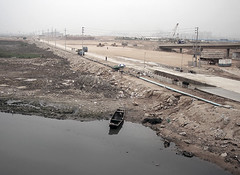
Sunday afternoon, I walked east along the Houhai coast, from Houhai to Sand River (沙河). This is a strip of land that was formerly designated to be part of the Nanshan District Binhai green zone, which connects up with the Shenzhen Natural Mangrove Reserve in Futian District. My interest in the area grows with the audacity of land reclamation in Shenzhen. This area marks a second rezoning of the coastline. The first was part of the effort to build the Binhai Expressway, which connects Nanshan to Futian and Luohu Districts. This second stage was districted later and remnants of that now-obsolete coastline litter the new construction site.

(The curious can check out the Shenzhen’s overall urban plan (1996-2010) maps, while the even more adventurous can go to the Nanshan District overall urban plan. On those maps, I walked along the strip of coast facing Hong Kong. Offline, if your library has any of the Shenzhen yearbooks from the 1980s, there are interesting comparisons to be made. Published in the early 1990s, the last Baoan County Gazetteer is also fun, but harder to find.)

On my walk, I stumbled upon guardhouses that were never staffed by border guards and the chain-link fence that separates pedestrians from Houhai. The entire area had been filled with earth and pumps were busy squeezing out the last of the ocean. Dump trucks rumbled past and people carrying nets biked out to the new coastline. I learned there was a two-week window to catch newborn crabs before they swam out into what remained of the ocean. These baby crabs would be used to stock fisheries in Baoan District. The crabbers carried the crabs in plastic soda bottles that hung around their necks. Eventually, I arrived at Sand River, I came across one of the construction sites for the Shenzhen Western Corridor Bridge, which set me to thinking about the various infrastructures which integrate Shenzhen and Hong Kong. What follows is a longish outline of Shenzhen history as mapped by Shenzhen-Hong Kong checkpoints. You can skip the discussion and go straight to the Western Corridor land reclamation pictures, or you can indulge my sudden urge to document comprehensively the transformation of Shenzhen.

(I’ve just realized that I only use Mandarin and Shenzhen place names in this blog. I promise to start documenting the different names for the sites. I may even talk about what these differences in talk might mean…)

Anyway, the fourth land connection between Shenzhen and Hong Kong, the Shenzhen Western Corridor Bridge was completed in January 2006. The corridor itself should be finished later this year. It is a 3.8 km long dual-carriageway 3-lane bridge connecting Nanshan District to Hong Kong at Ngau Hom Shek. The construction is being overseen by OPAC, a San Francisco based engineering firm. Trying to figure out the actual cost of the corridor is somewhat difficult. According to the China Daily, the bridge cost $US 111 million to build. On their webpage, OPAC estimated that the cost of the Western Corridor Bridge would be $US 400 million. The Nickel Institute website quotes the Hong Kong Highway Authority as putting the estimated cost at $US 2.7 billion. Perhaps the China Daily quote refers just to the cost of the bridge, the OPAC quote to the cost of the entire corridor, and the Hong Kong Highway Authority quote to related infrastructure in Hong Kong. What can be concluded is that the corridor is expensive and somebody is making a lot of money from it.

And making money seems to be the point. The Western Corridor Bridge is part of a larger effort to transform the Pearl River Delta into one of the most vibrant economic regions in the world. On August 28, 2003, at the Foundation-stone Laying Ceremony for the Hong Kong-Shenzhen Western Corridor in Shenzhen, Hong Kong Chief Executive, Mr Tung Chee Hwa said, “Hong Kong and Shenzhen are a key nexus in land transport to the Mainland…The three existing land boundary crossings between Shenzhen and Hong Kong are nearing the saturation point, such that both administrations have agreed to build the Hong Kong-Shenzhen Western Corridor as the fourth land crossing to accommodate growth. Traffic flows at the three existing boundary crossings have increased greatly over the past five years. The average total daily vehicular traffic at boundary crossings is expected to reach 65,000 vehicles in 2006, far beyond the daily capacity of 42,000 vehicles, which the three existing crossings offer now. Upon its completion, the Western Corridor will provide additional daily traffic capacity of 80,000 vehicles, raising the overall daily traffic capacity to 122,000 vehicles, thereby easing the current congestion. And yet, even four land crossings are considered inadequate to meet the future demand arising from further development. A working group drawn from among officials of the Hong Kong, Guangdong and Macao administrations will convene its first meeting tomorrow to press on with the advance preparations for construction of the Hong Kong-Zhuhai-Macao Bridge…”

The figures for vehicular land crossings do not include statistics for all border checkpoints (in order of numbers of passenger crossings)—Luohu, Huanggang, Shekou, Shenzhen airport, Wenjindu, and Shatoujiao. Official Shenzhen customs figures showed entry and exit passengers at the city’s six checkpoints reached 137 million in 2004. Crossings surge during Chinese holidays, especially Chinese New Years, when an estimated 5-6 million people (over a period of two weeks) cross at Luohu alone. During the holiday season, all checkpoints extend hours and increase staff handling document inspection. Each of these crossings has a distinct, but interconnected history that illuminates different aspects of the Shenzhen-Hong Kong nexus as part of globalization. A crude synopsis of the six sites follows and provides a very, very, very rough outline of Shenzhen’s deep history.

(I try to problematize the idea of history with respect to Shenzhen most entries. However, this is the first time in this site that I’m trying to locate Shenzhen with respect to larger currents. I’ve learned how to think about this history from Giovanni Arrighi in his wonderful book The Long Twentieth Century. Helen Siu and David Faure have turned an anthropological lens on this process in Down to Earth: The Territorial Bond in South China. I’ve picked up some online sources that may be helpful and embedded in the following notes. I assume it’s all as reliable as statistics about Western Corridor Bridge finances are.)

In a certain sense, the Luohu checkpoint has been in existence since the leasing of the Hong Kong New Terriories in 1898, when the Sino-Anglo border moved to the Shenzhen River. Previously, the Qing Dynasty had ceded Hong Kong Island and the area south of the Kowloon Mountains to Great Britain in 1842 (end of the first Opium War) and 1860 (end of the second Opium War), respectively. Luohu (Lo Wu in Cantonese) was the first stop on the Chinese side of the Hong Kong-Guangzhou railway, which was built in 1913 and more effectively integrated south-eastern China into the British Empire. So thinking about Luohu leads to thoughts about British imperialism, the transition to the Cold War, and the postsocialist realignment of international political-economies with a focus on East Asia. Suddenly, Shenzhen is neither hinterland nor no man’s land, but vying for the center of global trade. In a recent defense of building the Hong Kong-Zhuhai-Macao Bridge and associated costs, the Executive Director of the Travel Industry Council of Hong Kong, Joseph Tung, has said that the Luowu checkpoint is one of the busiest land crossings in the world, with more than 90 million people passing through it every year.

The Huanggang Checkpoint opened for 24-hour border crossings Jan. 27, 2003, at which point crossing figures surged from 50,000 to 110,000 per day. Buses to and from the Huanggang Checkpoint, connect Shenzhen to six Hong Kong destinations, including the Hong Kong airport. Since 1995, Huanggang has been the primary conduit between Shenzhen and Hong Kong Disneyland. Until the construction of the Western Corridor Bridge, Huanggang was the newest of the land crossings. It is interesting because it was part of a geographic shift in Shenzhen from “Downtown” referring to Luo Hu to the new “City Business Center” in Futian. The shift began in 1996, when the Shenzhen Municipal Government accepted plans for the new CBD. Michael Gallagher gave a talk about the Shenzhen CBD in 2002. But for a sense of the scale of this transformation and the debate about it, google 深圳CBD and check out all the different sites. Thus, the shift from Luohu to Futian allows for specifying the differences between a Hong Kong centered development in the early 80s to a more diffuse integration of the region, and therefore a more Mainland-centered pattern of economic development.

The most expensive connection between Shenzhen and Hong Kong, the Shekou ferry makes 13 round trip voyages a day, except during Chinese New Year, when the number of trips increases to accommodate the numbers of visitors. An additional 8 daily voyages connect Shekou to the Hong Kong airport. Most frequent passengers on the ferry are Shekou-based foreigners. The Shekou Ferry is interesting for a number of reasons, most related to the role that China Merchants has played (by way of Shekou) in the development of Shenzhen. The role of China Merchants then leads back to Luohu and questions of national development first raised during the later years of the Qing Dynasty. As of 2004, China Merchants has posted its own historical archive online, which highlights the role that commerce and international relations have played in modern Chinese history.

Along with Hong Kong, Guangzhou, Zhuhai, and Macau, the Shenzhen Airport is one of five international airports in the Pearl River Delta. In terms of passengers served, it ranks behind Hong Kong and Guangzhou. The five international airports have been built within a radius of 25 km. illustrating the level of competition and inter-city rivalry that has characterized development in the Pearl River Delta, rather than regional cooperation and planning. Moreover, the redundant infrastructure in the Delta has led to serious environmental problems, according to a report by K. C. Ho and C. S. Man.

Wenjindu is primarily a crossing for goods between Shenzhen and Hong Kong. It was opened in 1950, as part of the new Mainland government’s strategy to bring hard currency into the country. Throughout the Mao-era, agricultural products flowed from the Mainland into Hong Kong, a development strategy that has been more fully exploited since Shenzhen’s establishment. So thinking about Wenjindu allows one to question commonly held understandings about China’s so-called isolation during the Mao era outside of the obvious connections with the former Soviet Union and other socialist and third world countries. In the era of Avian flu, Wenjindu regularly appears in Hong Kong news reports as the site where chickens and other poultry cross the border. With suspicious regularity, indeed with an almost ritualized compulsion, Hong Kong public health officials regularly express astonishment on conditions north of the border.

So a rough outline of Shenzhen’s history with respect to the construction, use, and re-appropriation of Shenzhen-Hong Kong border checkpoint infrastructure. It touches upon British imperialism, the Cold War, the East Asian economic miracle, the rise of China as a global player, international epidemics, and the concomitant transformation of the environment. This is how we make our world, one reclaimed special zone at a time.

Ruins


tryst
Originally uploaded by mary ann odonnell.

Another online publication. This time, photos primarily from a Hakka compound in Pingshan, Longgang District Shenzhen. “Ruins” are up in the January edition of Tryst. To visit the most recent edition, please go to http://www.tryst3.com and enjoy.

Dongmen zoo


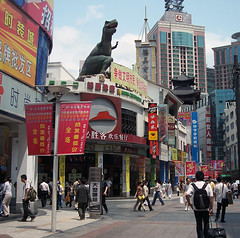
t.rex, dongmen
Originally uploaded by mary ann odonnell.

Walking through Dongmen the other day, I suddenly noticed T.Rex was not alone. A giraffe, horse, and Thai elephant also roamed Shenzhen’s most famous shopping area. Check out the menagerie.
.

shekou: symbols of globalization

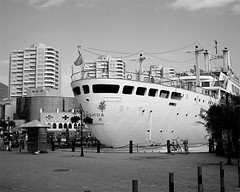
Although my last entry about Bitao Alley focused on one architectural manifestation of globalization in Shekou, the most famous architectural sign of Shekou’s march to a global future is in fact the Minghua luxury liner.

Over twenty years ago, the Shekou People’s Government bought the Minghua from France and docked it in the port. At the time, the Minghua floated and Chinese guests had a sense of embarking on an international cruise. In 1984 Deng Xiaoping boarded the Minghua and, pleased with what he saw, wrote the four characters for seaworld (海上世界), which now grace the ship’s entrance. Throughout the 80s, the Minghua symbolized exotic consumption. Western restaurants and shops sprung up in the area around the ship; this is today’s Seaworld Plaza. However, by the 90s, the Nanshan District, Houhai land reclamation had spread along the coast, landlocking the Minghua. The ship fell into disuse and the newly created land next to it was turned into a golf practice field. At the turn of the millennium, Seaworld Plaza underwent an international facelift and the Minghua was restored as a luxury hotel and restaurant.

For Chinese visitors to Shenzhen, Seaworld Plaza is an important destination. They buy foreign knicknacks at kiosks, take their picture in front of the Minghua, and sometimes enjoy a foreign meal. Next, they walk along the ocean walk to take their picture with Nuwa, who saved humanity by mending heaven. The ocean walk is now also landlocked, but before, Nuwa stretched into heaven, the ocean at her feet. I confess that the mythological turn confuses me, not that I’ve asked anyone involved with the project what it once meant. According to legend, Nuwa first sutured the rent in heaven and then cut off the feet of the great turtle to support the four pillars of the universe. She also stopped the flood that had surged through the rent and finally drove away fierce beasts that had taken advantage of the chaos. Clearly a heroine. But I’m not sure what she’s mending in Shekou. The ocean? Communism? The separation of Hong Kong from the Mainland? Whatever the wound, landfill now stretches way past Nuwa, creating a new coastline and new room for the development of beachfront property.

The Minghua illustrates how spaces of sanctioned consumption have provided legitimacy for the globalization of Shekou. In particular, globalization has arrived as the consumption of Western culture. The beached luxury liner anchors the western restaurants and stores of Seaworld Plaza through the promise of global consumption. Indeed, for many years, Chinese tourists rented binoculers and looked toward Hong Kong across the water.

A friend once warned me against buying beach front real estate in Shekou, where, “Just as soon as they sell the last lot, they start over again, creating a new coast line.” Recently, however, Shekou’s newest coast has been turned into an upscale beach community, that echoes the western style of Seaworld. Unlike earlier homes that were built to entice western businessmen, these homes have been built for Shenzhen’s white collar workers, who now expect and enjoy a material standard of living often higher than that in Europe or the United States.

The irony, of course, is that the factories which have enabled consumption elsewhere in the world are a block away from Seaworld Plaza. There too one finds housing and urban villages that were built in the 1980s, when the Minghua floated. And that’s perhaps the point. These factories were to provide and ultimately did provide the means of Shekou’s globalization. Like the Minghua, these once-necessary buildings fell into disuse and disrepair in the 90s. Unlike the Minghua, however, these buildings were once sites of manufacturing. Today, they are one by one being rennovated to facilitate new forms of consumption as manufacturing gets pushed out of Shenzhen into Dongguan, which has recently appealed to me more and more. Someday soon I’m going on a photo-trip to Dongguan and look forward to reporting back. Until then, I invite you to take a tour through and around Seaworld Plaza, Shekou.

Visiting the Nanyue King Mausoleum

The other day I went to the American Consulate in Guangzhou and, before returning to Shenzhen, I visited the Western Han Nanyue King Museum. Like my visit to Xi’an, this visit helped clarified some of the contradictions that animate the construction of Shenzhen by indexing both national trends and regional specificity.

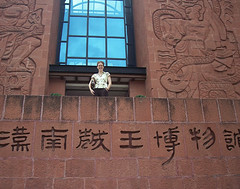
Located on Jiefang Bei Road in Guangzhou, the Museum of Zhao Mei, second king of the Nanyue State of the Western Han Dynasty (206 B.C.-24 A.D.) is the oldest and largest Han mausoleum in Lingnan. The simple act of walking through the museum suggests the way architecture not only sutures one era to another, but does so by highlighting the radical differences between eras.

The site was discovered in 1983 when developers began leveling Elephant Mountain in order to build needed housing. At the time, Guangzhou and the other 13 coastal cities were still a year away from reforming and opening the local political-economy. This is important because the housing built at the time, housing which now surrounds the museum was built under the Maoist work unit system. Consequently, Stalin inspired apartment buildings surround the museum’s modernist silhouette.

The museum complex consists of two main buildings—the exhibition hall and Zhao Mei’s mausoleum. Architect, Lu Yanzhi won the Liang Sicheng prize for its striking modernism. Green grass and sculpted topiary set off the buildings’ red stone base and glass pyramids. Walking from the exhibition hall toward the mausoleum chamber, however, my eyes kept moving from the set scene toward the spill of Stalinesque housing and Maoist factories. Two kinds of cognitive dissonance kept my eyes darting from the museum complex to the surrounding environment. First was the obvious difference in upkeep between the museum’s well-tended garden and the neighborhood, which seemed to be crumbling. Second was the City’s glorification of ancient history and the implicit denial of the importance of both Mao and Stalin to Guangzhou. After all, in order to build the museum, a building project was put on hold. Yet the surrounding neighborhoods will be razed as soon as it is economically feasible to do so.

I suspect several factors contribute to the social production of these differences. One might be historical age. 25 years really isn’t all that much in comparison to 2,200. Another might be rarity. There is only one mausoleum and many, many crumbling monuments to Stalin. There’s also a hint of elitism—tourists and political leaders agree that dead kings continue to matter more than living commoners, even as the museum implicitly sutures contemporary Chinese society to past empires without actually acknowledging the Cultural Revolution.

All these contradictory impulses animate Shenzhen, of course, but they seem so much more obvious in Guangzhou, where a longer urban history makes it both easier and harder to erase the recent past in favor of imperial glory. On the one hand, there actually are significant archeaological sites in Guangzhou which make imperial claims seem viable. There are several interesting sites in Shenzhen, but they’re either far away from the beaten path so unvisited except by foreigners or rennovated beyond recognition; Shenzhen’s imperial claims (except for Diwang and that’s imperialist of a different kind) feel contrived. On the other hand, Shenzhen has more or less successfully razed traces of the Maoist past. A few Mao heads remain on older village walls, but Mao-era buildings, especially of the industrial urban kind didn’t fit into Baoan County’s plan, so there wasn’t much past to deny, unlike in Guangzhou. But again, precisely because Guangzhou has this deep history and the odd archaeological site, the city might gets tied up in debates that Shenzhen easily sidesteps with the claim, “There was no history here,” moving right along with the task of building a modern international city. All this to say, that even if erasing history seems pretty straight-forward–raze a building here, don’t mention the factory that used to be over there–it doesn’t follow that its easy to rewrite the past simply because garbage accumulates despite our best intentions. The stubborn fact of unwanted (or once-wanted-now-denied) buildings and highways and stores now vexes Shenzhen leaders intent on handling the municipality’s urban villages, ironic remnants of Shenzhen’s earlier boom, which doesn’t count as “history” and so, by definition, needs to go.

The social differences staged by the museum and its immediate environ are lived on the steps to the museum entrance, where recent migrants sell artifacts to tourists. The day I visited, three young men from Gansu tried to tempt me into purchasing animal skins. (I’m not sure if they were real or not, but suspect the latter simply because in Shenzhen all the folks who traffic in wild animals have gone underground and one needs a personal introduction to eat alligator and badger.) When I asked who bought their skins in this heat, they laughed and said, “People like you.” They helpfully offered to take my picture for the memories; I took theirs’ for the same reason. Come tour theWestern Han Nanyue King Mausoleum
.

bitao alley—the morning after


i love you
Originally uploaded by mary ann odonnell.

The school I work for is currently going international. Consequently, I’ve been going to an international school in Shekou to meet with administrators and teachers in order to figure out what to do. The school is located right next to the infamous Bitao Alley, where sex and money get mixed up in soul-chilling ways. Bitao Alley is lined by bars that cater to the many single Western men, who live and work in Shekou. At night, music blares and there’s a sense that people are trying to forget where they are, or rather trying to get someplace else through each other. Most of the Chinese women have come from poorer areas in China’s underdeveloped rural areas and are looking for boyfriends or husbands, while the Western men seem determined to pretend they aren’t in China and haven’t bothered to learn even enough Chinese to give a taxi driver their address. So it’s never clear who’s using who, and a desperate insecurity infuses the relationships that litter Bitao. One morning I was in a Seaworld coffee shop eating brunch, when I overheard the following conversation:

He: “You’re a liar…”
She: “We just met for coffee.”
He: “A liar. You lie about everything.”
She: “You don’t understand.”
He: “You told me you were staying at home. And then you went out for coffee.”
She: “My friend called…”
He, throwing hot coffee at her: “Liar.”

She wiped the coffee up and started read a newspaper, while he continued yelling at her. I turned around to ask her if she need help and she said no. I then asked him to tone it down, but by then, most of the other English speakers had left the coffee shop. Distressed, I also paid and left the two of them there.

The political-economic background to this scene is common to most ports, where the sudden influx of capital usually means the arrival of single men, who are overpaid relative to the local economy and hookup with local women as a strategy for negotiating their very real loneliness and cultural incompetence. Bitao Alley is located in center of Shekou, which was the first area in Shenzhen opened to foreign capital. Even before Shenzhen had been established, the Shekou Industrial Zone was open for business. Until municipal restructuring in the early 1990s, Shekou was independent from the municipal government. So important was Shekou to Deng’s image of Reform and Opening that in 1984 during the meetings to discuss opening the fourteen coastal cities, Yuan Kang, Shekou’s head officer, rather than Liang Xiang, the city’s mayor, represented Shenzhen in the discussions.

Like Overseas Chinese Town, Shekou has been administered by a governmental ministry for economic ends. China Merchants was a branch of the government responsible for overseas trade. This model represents an expansion of a similar pattern in downtown Shenzhen, where different ministries and provincial governments were allotted land to pursue economic projects. Overseas Chinese Town and Shekou, however, are much larger and unlike Overseas Chinese Town, Shekou’s initial political independence continues to shape local politics and investment patterns. Indeed, China Merchants, the Ministry that ran Shekou is now one of the largest enterprises in the country, with interests ranging from financial services, shipping, and real estate to manufacturing and new technologies. For a sense of the scope and range of the company’s investments, visit China Merchants Group, where Shekou is only one of many projects.

Importantly, Shekou is also the headquarters for Chinese oil exploration in the South China Sea, where sovereignty debates continue to vex development. Seven countries have diverse claims to the region: Brunei, China, Indonesia, Malaysia, Philippines, Taiwan, and Vietnam. Not unexpectedly, representatives from the Seven Sisters oil companies (Exxon, Shell, BP, Mobil, Chevron, Gulf, Texaco) are based in Shekou. For a dated but relevant synopsis and map of the claims and disputes please visit the Department of Energy’s briefSouth China Sea Tables and Maps. I’ve heard, but not confirmed that the foreign companies shoulder all exploration expenses and then when oil is discovered split profits with the Chinese government. I’m sure there are more complicated negotiations that go into dividing up tracts, especially given the international sovereignty debates. You can also check out China Merchants petro-businesses on their website.

What is interesting about all this, is that for many Chinese, Bitao Alley both actualizes and provides a working metaphor for all that is wrong with the way that Shenzhen has reformed and opened. So pervasive is this sense, that in everyday conversation, the expression “开放”, which means to open, also means to be sexually liberated tending toward the promiscuous. In contrast, “改革”, which means to reform has retained its political meaning. On the one hand, it is considered inevitable that bars, which traffic in sex came to mediate the relationships between relatively wealthy white businessmen and relatively poor Chinese women. After all, as a popular expression has it, “men go bad once they have money, while women are only bad when they’re poor (男人有钱就坏,女人没有钱才坏)”. In Shenzhen, not just white men, but men in general—men from the Mainland, Hong Kong, Taiwan, Korean, Japan, and Singapore—have taken advantage of relative privilege to indulge in relationships that they might not have been able to pursue at home. On the other hand, the white man-Chinese woman relationship often stands for the feminization of China with respect to the West. Suddenly the problem seems not one of gender inequality, but racial/national inequality in which local women’s issues get subordinated to national goals.

Speakers who invoke the white man-Chinese woman metaphor to illustrate what’s wrong with globalization rarely question the fact that throughout Shenzhen women work in jobs that pay less and carry fewer benefits than do “masculine” jobs. Instead, what is lamented is the imperiled status of China’s masculinity. China’s men, it seems, aren’t manly enough. If they were, the argument proceeds, then Chinese women wouldn’t have to work in Bitao Alley bars. The corollary—that a wealthy Chinese man could import or go abroad to use white sex workers—remains unmentioned. Nevertheless, a desire for China to fuck the world seems to hum beneath the surface of such conversations. At the level of popular culture, this desire takes the form of scantily clothed Russian dancers performing in Las Vegas-style numbers at Shenzhen’s popular resort, Window to the World, while some Chinese men do go to Thailand on less than savory tours. This topic has received both popular and scholarly attention. In China Pop, Jianying Zha reports on this phenomenon, while Xueping Zhong provides a more theoretical version of this story in Masculinity Besieged? In the spirit of fair disclosure, I should also mention that I provided my husband with the material to write an award-winning skit about what it means to be a white woman in China. The translation of “Neither Type Nor Category” was published in TheatreForum, Issue 27, Summer/Fall 2005.

For a sense of the gendered despair that radical inequality between nations produces, you could do worse than visit Bitao Alley.