5 minutes in luohu (蔡屋围)


1 alley

Originally uploaded by maryannodonnell

luohu seethes contradictions, especially in the area surrounding the train station and railroad tracks, which connect shenzhen to hong kong (in the south) and guangzhou by way of buji and dongguan (in the north). in fact, the area immediately surrounding the railway station is frequently (and distastefully) referred to as “chaotic (乱).”

this part of the city was originally part of caiwuwei (蔡屋围), location of the previous administrative headquarters of bao’an county (once it was moved from nantou in 1953). consequently, it was one of the first areas occupied by national work units that built shenzhen. in fact, this area is one of the few in shenzhen where there are work unit residential compounds.

although shenzhen’s explosion has repeatedly transformed caiwuwei, the area’s historic importance has meant that past buildings and dreams accumulate in the shadows of upgraded versions.

i have uploaded a five minute walk through two blocks of caiwuwei. it begins in the alley next to the the ministry of shipping compound (航运大院), scuttles through the driveway entrance to the chengshi tiandi plaza, crosses bao’an south road and moves through the newer section of the mix-c mall to park lane manor.

the point of this walk is not simply to draw attention to the contradictions that structure everyday life in shenzhen, but also to emphasize that critical irony is built into the physical environment. benjamin reminds us that when innovations appear in modern life they do so by calling attention to the past. and not merely any past. but collective dreams and fantasies for completion and wholeness that have not yet been satisfied.

pay attention. the the mix-c’s name in chinese is 万象城 – “city of every phenomenon”, evoking the dao de jing, where “the way gives rise to one, the one to two, the two to three, the three to every phenomenon (道生一,一生二,二生三,三生万物). ask yourself. if the way is not capitalism (with or without chinese characteristics), what is it?

do not remove sketch


do not remove sketch

Originally uploaded by maryannodonnell

’nuff said.

for a wonderful gallery of shenzhen grafitti, visit the western bank of the shahe river bridge at binhai road. the old new coastline has been filled in, roads laid, and the river securely cemented in place. all is in place to continue extending the park. before that happens, visit.

to get to the gallery, it’s best to go to hongshulin park and walk west until you reach the shahe river: if you follow the water, you’ll even get a nice view (on a clear day) of the western corridor bridge and one of our many connections to hong kong. you’ll also have a view of the edges of land reclamation and the remnant wooden boats that anchor at docks strapped together out of styrofoam, bamboo, and plastic string. the eastern bank of shahe is at the furthest edge of the baywalk park that hongshulin is growing into.

(yes, just last week i realized that xiasha is renovating with an eye to integrating into this extensive park and wanke has donated strange log cabin / guard stands to hongshulin.)

if you walk from the west (as i did), begin at coastal city. walk past the kapenski, shuffle across the binhai on ramp and follow the wall that says “western district land reclamation area”. at different points, you can jump onto the landfill. keep your eyes open for granite posts. these were once the safety chain links along the former coastline and proposed extension to baywalk park. pay attention to the names of the buildings – not just “coastal city”, but also “river’s edge” and “bayview”. many of these residences and shopping areas were undertaken before the coastline was redrawn. be sure to notice the motley crew of puppies that guard another patch of squatter gardens and chicken coop. bring water. the walk takes about 90 minutes and the sun is hot.

thinking food: images from the houhai overpass, 2002-2010

this post is a brief contextualiztion of  china lab’s  landgrab city exhibition for the shenzhen-hong kong biennale 2009. the exhibit draws attention to the the ways that cities are imagined without reference to the countryside and food production. it also usefully brings china into international conversations about urbanization.

The countryside is a vital but frequently overlooked category in the contemporary discourse around spatial policy, and its role with respect to the future of urbanism is more often than not neglected. Landgrab City is an attempt to visually represent the broader spatial identity of the 21st century metropolis; it proposes a new spatial definition of the city and thereby a more complex understanding of urbanism, one that no longer considers city limits as the boundary of its remit, but instead looks beyond – even across international borders – to the spatial, social, economic and political implications of the planet’s rapid urbanization.

i support efforts to think about food – its production, distribution, unequal consumption – are all critical to how shenzhen is imagined, experienced, and reproduced. nevertheless, this exhibition disturbs me because it discusses shenzhen as if the city were one wealthy enclave, rather than an amalgamation of enclaves -rich, poor, and destitute, which abut and constantly disrupt one another.

shenzhen has sold itself and reform in precisely the terms that china lab uses to describe the city’s “reality”. unfortunately, by taking shenzhen’s self-promotion as fact, rather than promotional fantasy, china lab overlooks  how rural migrants inhabit and  transform shenzhen. this silence distresses me because the spatial, social, economic, and political consequences of shenzhen’s modernization are not implied; they are facts of life for many migrants.

so a very simple point:

In reality, of course, these agricultural territories are not actually clustered around Shenzhen, as in the installation, but scattered across China and contiguous regions.

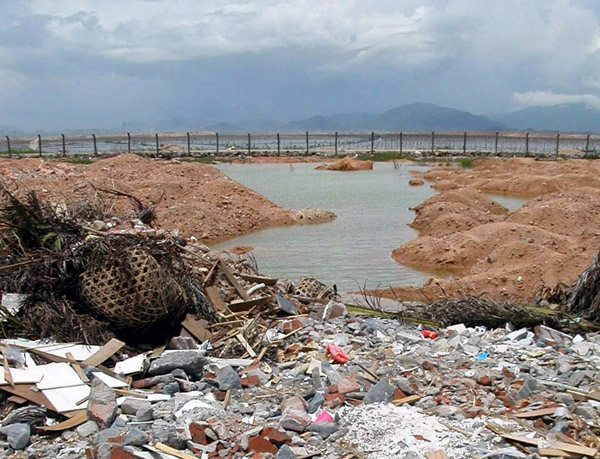
counter point: a five minute walk from the land grab project, agrarian squatters have persistantly grabbed, evacuated, and reoccupied  a portion of the houhai land reclamation area to grow food, which they eat and sell. the differences between overpass then and now are now are instructive because they illustrate both the persistance of shenzhen’s rural poor as well as their increasing destitution.

the map below locates the land grab project with respect to several generations of agricultural squatters at the houhai overpass.  pictures of the squatters and their gardens, here.

the houhai overpass is located at the intersection of houhai and binhai roads. in the map, the squatter areas are located in the southeast quadrant of the intersection, coastal city in the southwest, and the land grab in the northwest. these areas are roughly a five minute walk from each other. in the map, the blue areas used to be underwater; the brown areas were not.

深大南区:the map is not the territory


the map

Originally uploaded by maryannodonnell

Once upon a time, this territory was ocean. There were oyster farms and fishing boats. And the people who lived here had single story homes that came to represent the poverty that these maps and plans would end.

The effort it takes to force territories into maps pulses through each inch of the houhai land reclamation area. Lines imagined elsewhere are being bulldozed, pounded, and moulded into six-lane highways and ten-lane expressways. Beside these roads climb glass buildings and residential developments with exotic gardens – palm trees, English grass, a goldfish pond, which is drained and cleaned once a month.

This is the territory – unmapped, but not unsung: Beneath the grey sky and rising walls of a high-tech research compound, a woman washes vinyl advertizing sheets for indigent tenting, paths veer in hidden enclaves that serve as public toilets, and a child plays on a piece of flatboard that has been placed protectively on top the mud.

Shenzhen’s poor are poorer than they were 15 years ago, when squatters had enough space and privacy to build small shelters beneath the lychee orchards that have also been imaginatively disappeared.

May the new year bring new possibilities.

chiwan 2009


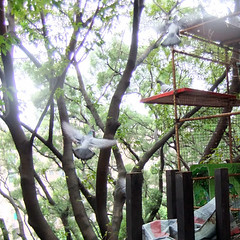
pigeons

Originally uploaded by maryannodonnell

today was the 15th of the 10 month of the lunar calendar, so i did what all good girls do – went temple hopping. chiwan is one of the natural harbors that constitute the port of shenzhen. before reform, chiwan could only be reached by way of a boat launched from shekou, heading north up the pearl river. today, chiwan is easily accessible by the 226 or 355, but still retains something of a backwater feel. indeed, chiwan has the scruffy feel of a potentially hip artist colony, except for the lack of artists and the vanishing coastline.

that said, chiwan is fun because it also boasts some of the oldest sites in shenzhen – the tianhou temple (technically the oldest in the area. zheng he reputedly stopped here, and emperors from the ming and qing gifted stele to commemorate upgrades and rennovations (!) to the temple). chiwan is also site of the grave of the last song emperor – a child who was drown with and by a loyal follower so he would not be dishonored by the yuan. the little emperor’s tomb is maintained by the zhao family.

hop, hop.

shenzhen university misty afternoon


lychee

Originally uploaded by maryannodonnell

had one of those delicious afternoons when the beauty despite blossomed. more snaps of shenzhen university trees, here.

Another Walk in Shenzhen

Poet Steven Schroeder and I have collaborated to create A Walk in Shenzhen II. The original Walk took place four years ago, 2005.

shenzhen bay 27 dec 2009

today i walked from the poly center at coastal city to circumambulate the construction site of the shenzhen bay sports center. i have started the walk with a that was then moment in 2003, which is today the point where haide 3rd road opens into houhai landfill in front of the kempinski hotel (now open for business). i started the walk from that same position today. the differences between the first and second pictures is only 6 years – but in terms of the production of real estate and growing air pollution problem it feels a lifetime; certainly another world. visit gallery to take the walk.


shazui

this afternoon, i walked through shazui, the village below my 31st floor windows and was struck by the odors and and the shadows. even though the streets are relatively wide, the cement is old and dank, the slabs of meat intimidating, and the people weary. shazui is an older industrial zone and where there is still work, chemical smells permeate the rows of factories. another section of the village has been upgraded and sells handicrafts and rocks, for half a million rmb. these pictures of the street. will add pictures of the cultural turn later.

Copenhagen 350

On December 10, 2009, students and teachers from Green Oasis School, Shenzhen, joined world wide vigils to limit carbon dioxide emissions. Scientists say that 350 parts per million CO2 in the atmosphere is the safe limit for humanity. Currently, we’re at 387 and rising.

10th grader, Ann Sheng organized students and teachers to march from the school to the park, including securing permits from the municipal government.

15 years ago, Shenzhen urban planners expected the population to use public transportation and bicycles. Today, Shenzhen has one of the largest car markets in China, and the city’s roads have been rebuilt to acommodate the huge number of private vehicles. 15 years ago, Shenzhen urban plans included green space and basketball courts. Today, those public spaces are now used as parking lots.

All this to say, already in Ann’s short life, air quality in Shenzhen has noticibly worsened. I hope her efforts and the enthusiastic support of her classmates and teachers help world leaders (yes I’m looking at you, Barack Obama and Hu Jintao) to reconsider their positions to represent the views of the people and not just car manufacturers.

pictures of the vigil, here.