Yesterday evening shared poetry with good friends old and new: Steve Schroeder, Walter Bargen, Clarence Wolfshohl, and Huichun Liang. Impressions, below:

Yesterday evening shared poetry with good friends old and new: Steve Schroeder, Walter Bargen, Clarence Wolfshohl, and Huichun Liang. Impressions, below:
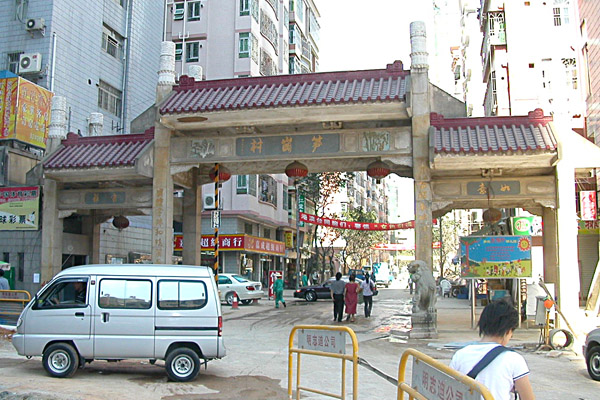
I have been reviewing my photo archives and came across pictures of new village gates that I took roughly ten years ago. The pictures show village gates old and new and point to the persistence of community identity precisely because it is malleable to the needs of the present.
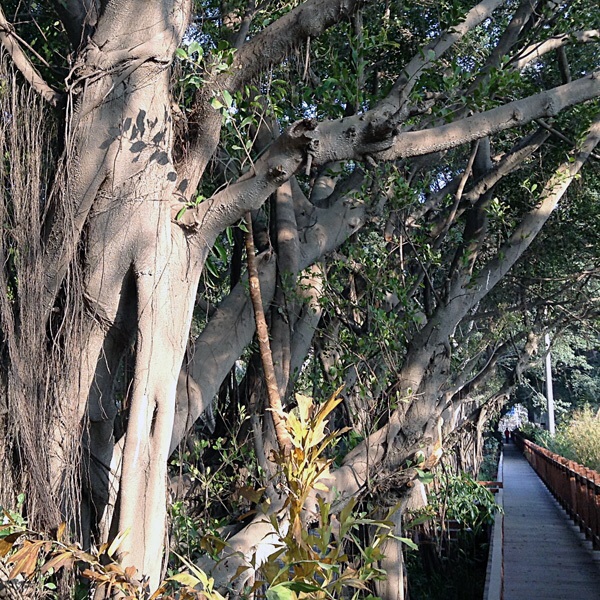
One of my favorite details at the Value Factory is the approach. Impressions below.

Apparently the Shenzhen school uniform is the talk of the national under 18 virtual community.
All Shenzhen public students wear the same uniform, regardless of the school they attend. On buses and in the subway, students either wear the elementary uniform or the high school uniform so one doesn’t know what school they attend, only that they attend. In fact, the Shenzhen school uniform is so recognizable that in the press and online it stands for the city’s youth. Thus, for example, the scandal of the youthful parents and their baby photo (from a tv series that admits high school students are having sex) as well as the explicit sexualization of Shenzhen little sisters in their school uniforms and a website for student couples to upload pictures of Shenzhen school uniform lovers.
Elsewhere in China commonality is marked by joining Party youth organizations because schools have their own recognizable uniforms. Cui Jian famously used the Young Pioneer red handkerchief to blindfold himself and in doing so evoked the trauma of a generation. In Shenzhen, the ubiquitous school uniform has taken on a similar generalizing function to the red handkerchief. However, instead of evoking a national identity, the school uniform symbolizes an explicitly Shenzhen childhood and teenhood.
I first heard about the national significance of the Shenzhen school uniform at a biennale forum. We old folks onstage were discussing if there was a common Shenzhen culture or civic identity. A student in the audience said there was. He mentioned that young people in Shenzhen have ideas and dreams that are shared, and also that these dreams and ambitions are different from the rest of the country. He then underscored his point by citing the omnipresence of the Shenzhen uniform both online and at Chinese universities. It seems that Shenzhen students continue to wear the dark blue sweatpants even after they get to college. Part of the charm, it seems, is that the uniform really is so ugly one grows to love it.
Back in the day, there was active debate both within and outside Shenzhen over how a civic identity might be created. Fortunately for us moldy oldies, the young people of the city have done it despite us. A selection of Shenzhen school uniform pictures, including a link to the highly popular digital comic book, Days When I Wore A Shenzhen School Uniform.

Shenzhen rushes forward, or keeps rushing forward. The Districts also hurry along toward goals that change with a shift in leadership. And yet the meetings drag. Even an hour. Drag.
Day before yesterday, Futian District invited me to observe their report on the work of the government. Wang Qiang presented. Highlights? The speed at which the economy continues to lurch upward. Futian per capita GDP hit US$32,700 surpassing that of South Korea. Indeed, the report of government work began with economic statistics and just kept pounding home the point — the business of government is, well, business. Futian fixed assests grew at 8.5 percent, exports surged 50%, and tax revenues grew at 7.7% surpassing all other districts. Futian has developed something called a “building economy” that is basically tax revenue from specific buildings. In 2013, five more buildings were added to the list of 68 buildings generating more than 100 million yuan in annual tax revenue. The economic focus is high-end industry and includes what is apparently called “headquarters economy (总部经济)” whereby a government attracts multinational companies to locate their headquarters in a particular territory. Apparently three Fortune 500 companies also invested in Futian.
Futian holds shopping festivals, electronics consumption festivals at Huaqiangbei, and is promoting commerce growth. The District has introduced six international or state level innovation centers, including the Cisco R&D Center and the Functional Materials Research Institute under the Chinese Academy of Engineering Physics. Futian is promoting intellectural property rights service intustries and a pilot zone for “technology plus finance development”. Intensive development of industrial land (Futian has many older industrial parks), online interface between the public and government, and more sophisticated forms of urban management — all are projects forwarded in 2013… anyway, you get the idea. Information dump. Drag.
But. There was a point (from the translated report):
Our achievements over the past year can be attributed to the correct leadership of the municipal committee of the CPC, the municipal government and the district committee of the CPC, as well as the efforts by the people of Futian.
The District’s English portal introduces Futian and its charms. To illustrate the ongoing transformation of Futian, I offer photographic impressions from the subway installation at Huaqiangbei.

A few shots from the performance! From handpuppets through sandcastles to silver models of buildings that landed like science fiction extraterrestials, urban fetish was a a celebration of creativity, desire and excess.

In Xintang, Baishizhou, this 60-year old gentleman has been protesting for a month. His demand? He wants the right to depend on his son for his old age care.
In Shenzhen, parents can transfer their hukou from hometowns to the SEZ based on their children’s hukou status. Once they have this hukou, they can take advantage of subsidized medical care from their 65th birthday. The problem? This gentleman’s son does not have a Shenzhen hukou. In addition, he does not own a house and is facing eviction upon the completion of negotiations to raze Baishizhou (admittedly at least two or three years in the future). At such time, he will loose his shop, and without equity in the building, will not receive compensation. So he is facing a perilous retirement.
The wording of the protest is of interest. 投靠 (tóu kào) literally means “throw oneself to depend upon”. It can also be translated as “become a retainer of”. Within the rhetoric of this protest, this gentleman is demanding the right to become his son’s retainer.
The form of his demand is similarly coached in feudal language; indeed his banners function as petitions to leaders rather than as social demands. He asks Xi Jinping, for example, if the General Secretary realizes that although in Beijing old people have welfare, the old people in Shenzhen have a different situation. He then asks Xi Jinping to visit Shenzhen and see the situation. Likewise, he asks Shenzhen Secretary Wang Rong and Shenzhen Mayor Xu Qin where the Communist Party is.
The moral economy of noblesse oblige gives these questions their oppositional force. The question put to Xi Jinping implies that if the General Secretary understood the true situation in Shenzhen, he would rectify it. The question put to Wang Rong is even more pointed: has the Communist Party abandoned its responsibility to take care of the people?
In order to make this moral claim, the gentleman also demonstrates that he has upheld his end of the moral contract between government and the future. First, he followed the one child policy and only gave birth to a son. Second, he came to Shenzhen twenty-three years ago to make a better life for himself and his family. During that time, his son was back in his hometown to go to school. Third, he never broke any other laws.
Shenzhen has been at the forefront of reforming its pension system. In practice, this has been the commodification of services. For those with Shenzhen hukou, there are still some benefits. However, as this gentleman reminds us, in the present real security comes through family ties and home ownership.

January 1, 2014. Shekou is preparing for the 30th anniversary of Deng’s 1984 visit to Shenzhen and Zhuhai, January 24-29. At the time, the tour was also an explicit celebration of Shekou, a different model of reforming and opening the Maoist apparatus. Images below are of renovations as of December 31, 2013. Yes, there is a light show. Yes, the transformers flash and when you ride the stationary bikes they blast a Beyond song that was popular in the mid-1980s. And yes, the Ming Wah is now in the water even as the coastline extends beyond Nuwa. Impressions of the upgrade, below:


On December 28, 2013 Da Ken Art Center (大乾艺术中心) opened an exhibition on the Devout and Chaste Girls School (虔贞女校), which was built as part of the Basel Mission. The opening brought together a strange but uncannily representative demographic — young Shenzhen gallerists (Da Ken specializes in early photography), Dalang officials, Hakka Christians, aging villagers who went or taught at the school, activists in Shenzhen’s literacy movement, and representatives from the Basel Mission in Hong Kong. There were also a good number of public intellectuals who came out to show support ongoing efforts to re-member Shenzhen history, Christian, nationalist, and pedagogical.
After the opening, Yang Qian and I had coffee with Zhang Yibin (张一兵) and Li Jinkui (李津逵), two of Shenzhen’s more active public intellectuals. Their interventions, however, take very different, albeit supplementary forms. Zhang Yibin is interested in objects — blunt and silent, stubborn bits of matter and how they become meaningful through archaeological speculation and what might be glossed as “cultural capitalism”. Zhang Yibin was responsible for rediscovering the school, which had been closed in 1986 and making its historic importance known to the Dalang government. He has been involved in the reconstruction and preservation movement for over six years.
In contrast, Li Jinkui is relentlessly and charmingly verbal. An economist by training, Li Jinkui came of intellectual age in the 1980s, when “economic reform” was a code for “social liberalization”. For several years now, he has organized a salon at Yinhu, where intellectuals gather to debate issues that range from urbanization through phenomenology and economics to the historic meaning of Shenzhen and include pedagogy in all its permutations — the social role of education, the importance of raising the level of education throughout Shenzhen specifically and the country more generally, the history of education, and the need to reform the Chinese system of education. In fact, Li Jinkui gently moderated our after opening coffee talk, which focused on the historic production of cultural ecologies.
Zhang Yibin’s analysis of the current Shenzhen preservation movement hinged on a two-pronged analysis of (1) non-material culture and (2) 闲钱, which can be translated as spare money, disposable money, or leasured money. Zhang Yibin noted that most cultural history is non-material, composed of stories and impressions and feelings and suppositions, while less than 1% of the archaeological record is actually material. He then reminded us that although the shapes, textures and sizes of objects vary, there is no meaningful difference between them in terms of historic preservation. Instead, we distinguish between relics and garbage, because of the stories we tell and how much “disposable money” is at hand; the more disposable money, he emphasized forcefully, the more we invest in objects and their social transformation into relics. The way disposable money mediates the social transformation of objects into relics clearly frustrated Zhang Yibin, who has failed more often than he has succeeded to bring Shenzhen’s archaeological record into the public sphere. Instead of an intellectual pursuit that helped to enrich a society’s cultural ecology, he suggested, historic preservation has become yet another instance of collecting relics. As such, it hinges on the whims of leaders rather than on a consensus over what constitutes history and archaeological research.
The background for his frustration is the robust Shenzhen antiquities market and concomitant disinterest in the area’s history. In Shenzhen, there are two primary agents accumulating relics — individuals and state cultural institutions, such as the Dalang Street Office. As elsewhere in the world, wealthy Shenzhen individuals collect for personal reasons that range from desire and taste to economic investment. At the same time, municipal cultural institutions have shown little interest in the area’s past, preferring to showcase the Municipality’s role in modernizing Post Mao China. Moreover, attempts at historic preservation at Nantou Old Street, Dapeng Fortress and the Hakka compounds, for example, have not been embraced by the general public, which remains largely ignorant of Shenzhen’s modern and imperial history. Indeed, even the call to preserve old Hubei Village, an example of a wealthy late imperial and republican architecture (located immediately east of Dongmen) has slipped well under public radar.
This background also explains Li Jinkui’s support for the collaboration between the cultural bureau of Dalang Street Office, the Lankou Christian community, literacy activists and Da Ken. Li Jinkui advocates a broader and more ethical understanding of public culture. To achieve this, he sees an important place for non-material cultural — not simply story-telling, but rather and fundamentally, education. For Li Jinkui, one of the roles of government is to use its disposable money in order to curate the City’s historical understanding. Although he agreed that only stories and money allow humans to differentiate between relics and garbage, it did not follow that all garbage ought to be transformed into a relic because not all stories were worth telling; we define ourselves, he suggested, through these stories. Moreover, the choice of how to dispose of one’s money, especially at the level of government, is for Li Jinkui and like-minded intellectuals a question of public ethics and the concomitant creation of social value. In this sense, the Dalang Street Office decision to preserve a school as well as the history of extending education to girls was a story that should be commemorated with objects and disseminated in public forums, such as Da Ken. In turn, Christians and literacy advocates can use this history and its objects to shape an ethical and heterogeneuos public sphere.
The exhibit itself integrates photography, examples of Republican textbooks, blue shutters from the school, and a virtual model of the planned reconstruction. The curatorial statement comes from a Christian apology for girls’ education:
China favors boys over girls. It is a custom with a long history. Many say that a lack of education is a virtue in a woman. But they do not realize that God made men and women as one body. God did not only give souls to men, but also to women. There were men, and then women were created. However, there were women, and then boys and girls could be born. In front of God, men and women are equal. Men strongly love education. But women love education even more because they are the nation’s mothers and they carry a heavy responsibility for the country. The country is made of customs. The people can have high or low character. Their words can be true or false. Their morality can be complete or lacking. All of this is created by the country’s mothers. The responsibility that women carry is therefore extremely heavy. It is an important moral obligation, which must be at the front of all future efforts to create the best model of moral words and deeds. We must work until we succeed.
For the curious, Tengxun has uploaded 22 photographs from the exhibition, which documents the cultural geography of fin-de-siecle South China. There are young Hakka girls, Western missionaries and their families, as well as impressions of the already globalized rural landscape — traditional row houses, fields, and the new school, shimmering white beneath elegant hills. The show itself is up at Da Ken Art Center, located in the northern section of Ecological Park, OCT (just above the AUBE offices and row coffee shops and restaurants). Hours, 10:00-6:00. Unlike the online exhibit, the actual exhibition includes objects and a model of the restored school and church.

We’ve known for a while that the Tangtou rowhouses had been condemned. In fact, for the second half of 2012 and a few months in 2013, CZC tried to rent a room for our art intervention, but could not because even though people still lived in the houses, there had been ongoing evictions. Instead, we ended up renting a handshake efficiency (302!)in Shangbaishi, near the Jiangnan Grocery Store.
Yesterday, I saw that they had actually begun the process of sealing off the alleys between buildings. But the eviction process is just that, a process and there are still signs of inhabitation. In addition, the well at the southern edge of the Tangtou row house plaza has been hidden behind a white screen. The screen, however, has created a semi-private area, where women seem more comfortable doing their laundry. In fact, I haven’t seen this many women working at the well in a while.
I also wandered south across Shennan Road into the actual Baishizhou, where the wall between the urbanized village and Window of the World dramatically announces mixed-use with post-modern characteristics. The Baishizhou side of the wall reads like a half-built and abandoned handshake building, while the WoW side models the Corcovado mountain range just outside Rio de Janeiro, where Christ the Redeemer blesses theme park visitors.
Impressions, below.
 Shenzhen Noted