Walk about pictures and bus, Dec 24.
This slideshow requires JavaScript.
Walk about pictures and bus, Dec 24.
Yesterday had lunch with friend and his son, a member of generation 90. The conversation turned to memories of life as an early 80’s college student in Beijing, while son politely played games on his phone.
Me: What interests me about your generation is that although today y’all are friends with your classmates, your children might not necessarily be friends because they are from different classes.
Old Zhang: That’s true. The country (国家) paid for us to go to college so once we were in, everybody was the same [economic] class. Now these young people have a hard time of it. I really feel sorry for them. [laughs] For example, falling in love. When we were in college we were all the same, so all you had to do was find someone you liked and then figure out how to open your mouth. But kids today [son looks up from cell phone], they have to match up everything – the right car and clothes and job and house. Love is just like salt, it’s the seasoning you add for flavor, not the dish itself.
[Old Zhang notices son looking up and continues in another vein]
This is why I’m encouraging him to get religious belief. It doesn’t really matter what. The point is that all our beliefs – in a better society, in the four modernizations, we achieved. There’s nothing left to do. Or, we don’t know what to do. That’s why belief is important.
Me: Or salt?
Old Zhang laughs, son goes back to game.
Gu Yun (she of the lovely biennale impressions) has taken photos of Boom! Shenzhen. Below are images from the show.
Boom! Shenzhen
In 1979, Shenzhen was a rural area, organized into collective fishing villages, lychee orchards, and oyster farms. From 1979 through 2010, the Municipality’s estimated population grew from 300,000 to over 13 million people, its GDP exploded from $US 308 million to over $US 149 billion, and agricultural land vanished, being replaced by international ports, industrial parks, residential areas, shopping malls, and green space. Indeed, Shenzhen’s boom redefined the scale and intensity of rural urbanization within China and set new standards for developing nations looking to modernize.
Boom! Shenzhen has five elements, which implode the idea of a timeline to contextualize the lived, environmental, and philosophical meanings of the SEZ’s short, yet volatile history. Continue reading
I have had the pleasure of participating in the “…and then it became a city“ workshops (活动照片), bringing the film series curated by David van der Leer to Shenzhen’s general public. The film series provides six answers to the question, “When do planned towns stop being new and turn into actual cities?” as filmmakers explore urban tipping points in Chandigarh, Brasilia, Gabarone, Las Vegas, Almere, and Shenzhen.
The workshops have a simple format. A screen has been installed in a city bus, creating a “third window”. As the bus travels through Shenzhen, visitors simultaneously view Shenzhen (outside the bus windows) and the city onscreen(through a “third window”). The juxtaposition of two new towns creates useful dissonance. Suddenly, the shared peculiarities of new towns become salient and cities that within their home context are decidedly atypical, abruptly make sense within the context of global modernization. For example, like folks in Shenzhen, people in Chandigarh live in large-scale concrete housing complexes, people in Botswana need to call ahead to be picked up because no one is familiar with new addresses, and people in Brasilia have found new ways to inhabit massive plazas and ongoing roads. Then, having viewed the films, we bring biennale visitors to a location in Shenzhen to discuss the question with the general public.
For those in Shenzhen, workshops will run through December 28, so come and think about when planned cities become living cities (报名). Impressions of workshop events, below.
Shenzhen photographer, Gu Yun (谷韵) has taken lovingly poetic images of Biennale exhibits. I appreciate these images for their intimacy. The biennale has presented massive projects at a scale that seems analytic and abstract; in contrast, Gu Yun’s images reveal her steps to engage individual works close up and personal, as we sometimes say. Indeed, Gu Yun has me thinking about the revealingly personal work of viewing, digesting, and appropriating objects. Enjoy.
Friend Jonathan Bach is in Shenzhen, researching questions around cultural / creative industry in the city and I have had the pleasure of thinking the issue through his questions. A few days ago, we went to F518时尚创意园 or F518 Idea Land, “The first experienced sharing space in China, Creative industry multi-commercial semi-tourist destination” – unquote from the website. While at F518, we spoke with Zhang Miao, the architect of area’s landmark hotel and planner of other similar creative spaces in Hangzhou, Guizhou, and Guangzhou, in addition to Shenzhen, asking, “What is cultural industry?.”
In brief, as practiced and promoted in Shenzhen, cultural industry refers to the production and consumption of cultural commodities, including stories and artwork and design. Continue reading
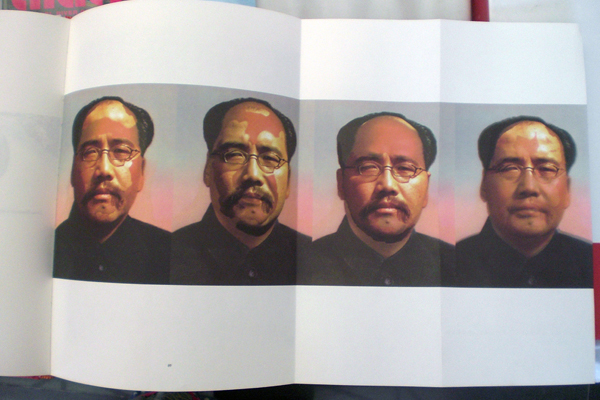
Visited the Wutongshan Culture Highland with friends, Jonathan and Gigi; resident artist director, Ryan Mitchell showed us the site. Of note, Zhao Shaoruo’s (赵少若) solipsistic exhibition in which he appears as every character in every painting and image. In addition to pieces in which he has substituted his face for Mao’s, Zhao has also produced work in the name of a variety of others, ranging traditional Chinese through Jews to insects. Telling, the only time that others appear in Zhao’s work, they do so as an extreme end of a continuum in which Zhao’s features are blended with his other.
Solipsists argue that the idea that only one’s own mind exists, that knowledge outside one’s own mind is unsure, or that only one’s own mind exists. Zhao’s relentless substituting his own face for those of others reminds us that extreme forms of solipsism are brutally pathological; I exist therefore you cannot. Continue reading
I participated in the “Learning from Shenzhen” Symposium on Dec 10, 2011, which was part of the biennale. For the curious, I’ve uploaded o’donnell-awkward encounters, a pdf file of images and arguments from the paper I gave.
Located between Lianhua Mountain and the ridge of low-lying mountains that once marked the second line, Meilin interests for several reasons.
First, Meilin completes the central axis in the same way that Hong Kong does – as an historic footnote. Meilin and Hong Kong are the implicit extensions of Shenzhen’s ideologically charged central axis, which announced the SEZ’s transition from an industrial manufacturing economy to a financial service and high-tech research and development economy. However, Meilin was built for functionaries in the 80s and 90s, and realizes the scale and type of residential area to which SZ once aspired. Likewise, Hong Kong was the orientation of SEZ globalization throughout the 80s and 90s, but like Meilin, it was globalization on a different scale. Shenzhen’s post axis global aims have long since reached beyond Hong Kong.
Second, the integration of Shang Meilin and Xia Meilin New Villages is neat because handshake building scale was the scale of 80s and 90s neighborhoods. Continue reading
I was privileged to speak at the Dec 11, book launch for Charles La Belle‘s Corpus and Guilty. To see the show, go to Saamlung Gallery in Hong Kong. To buy a copy in Shenzhen, visit the Old Heaven Bookstore in OCT. Response, below:
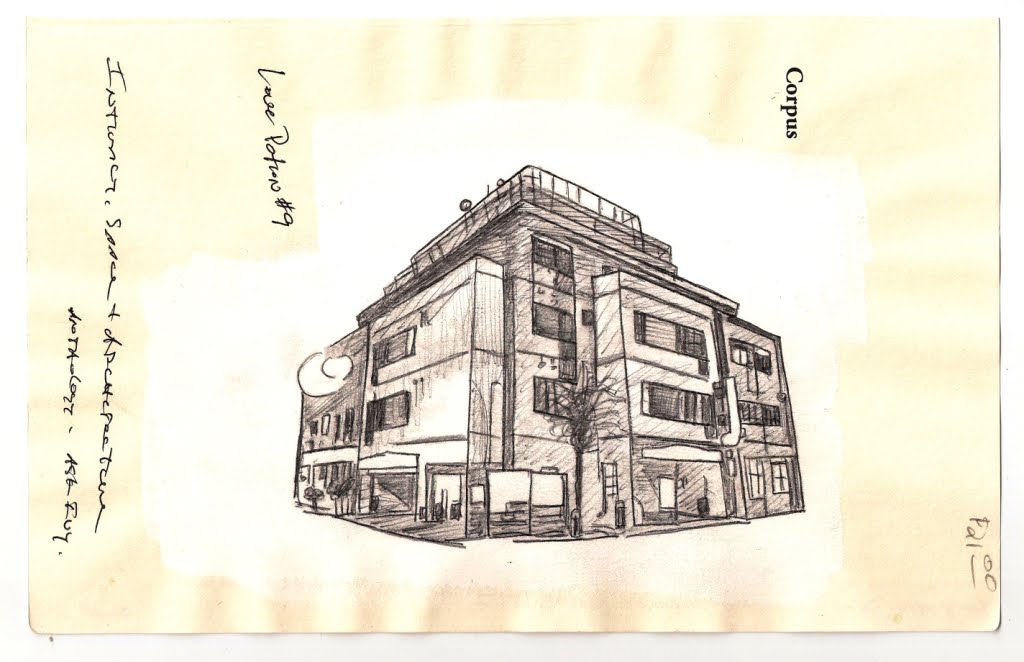
Charles La Belle’s artistic process of layering time and experience in a book that is simultaneously reread and rewritten reminded me of how Walt Wittman lived and in living wrote and rewrote, Leaves of Grass. Between 1855 and 1892, Wittman quite famously published no fewer than nine different editions of Leaves; over the past fourteen years, La Belle has published two volumes that relate to one ongoing project. This intellectual ebb and flow, the sentimental return and reevaluation, self-promotion and in-your-face jouissance enabled Wittman to voice and in voicing inhabit the expanding, teeming, writhing, and destabilizing emergence of a uniquely American identity. Likewise, La Belle also performs an artistic stutter-step to more fully inhabit the unruly emergence of post Cold War, post socialist, post modern, post industrial globalizing and globalized urban identities.
“Buildings Entered,” La Belle’s life work is best aligned with Wittman’s spiritual wandering at the level of process. Like Wittman, La Belle has chosen one medium and one theme to which he constantly returns; like Wittman, La Belle grapples with the problem of transforming mere being into the well-lived – and yes, this is the ethically well-lived – life; like Wittman, La Belle accepts the immanent mysticism of ordinary human lives. The building first entered, like the open road invites each of us to inhabit the unknown.
In terms of content, however, over a century of industrial expansion and relentless capitalist urbanization separate Wittman from La Belle. Continue reading
 Shenzhen Noted